A Dark Song (2016): The Ritual Worked. That May Be the Problem.
Introduction: All That Occult Shit Just to Become a Good Girl?
There is a point near the end of A Dark Song when Sophia has endured just about everything a grieving mother could reasonably be expected to endure in pursuit of forbidden knowledge. She has sealed herself inside an isolated house. Submitted to months of ritual deprivation. Starved. Bled. Vomited. Pissed into bottles. Drawn circles. Studied magic squares. Survived a dangerously unstable occultist, a demonic incursion, and enough ceremonial procedure to make Aleister Crowley suggest everyone take a long weekend.
Then the Holy Guardian Angel appears.
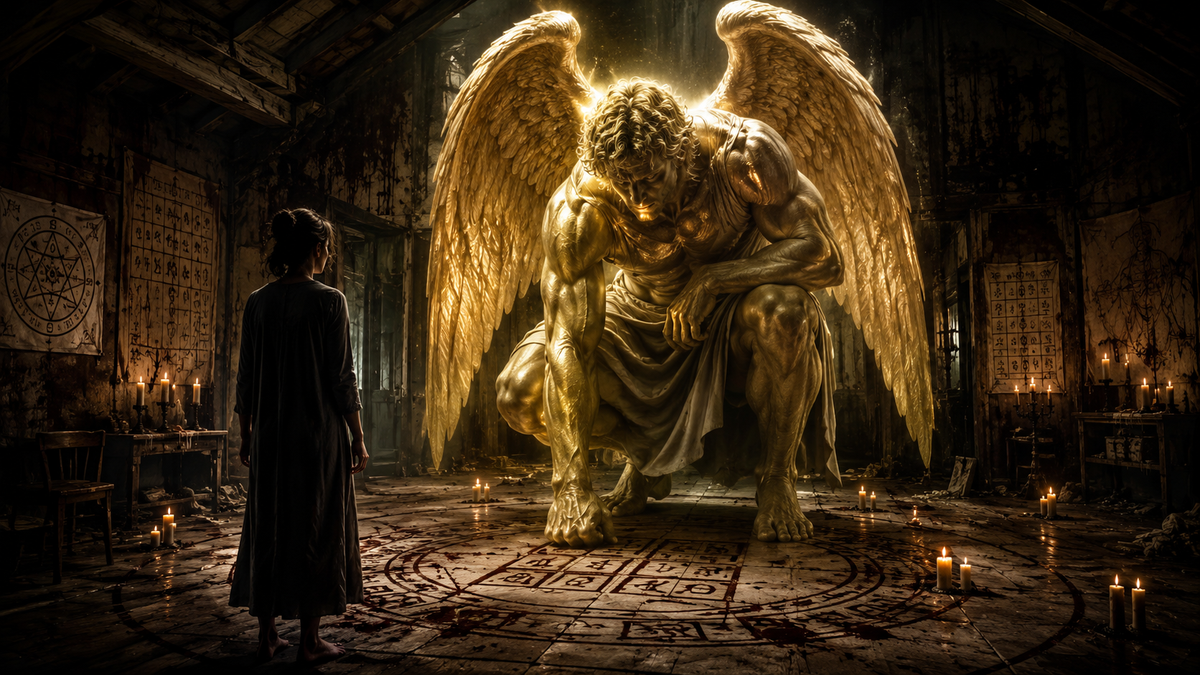
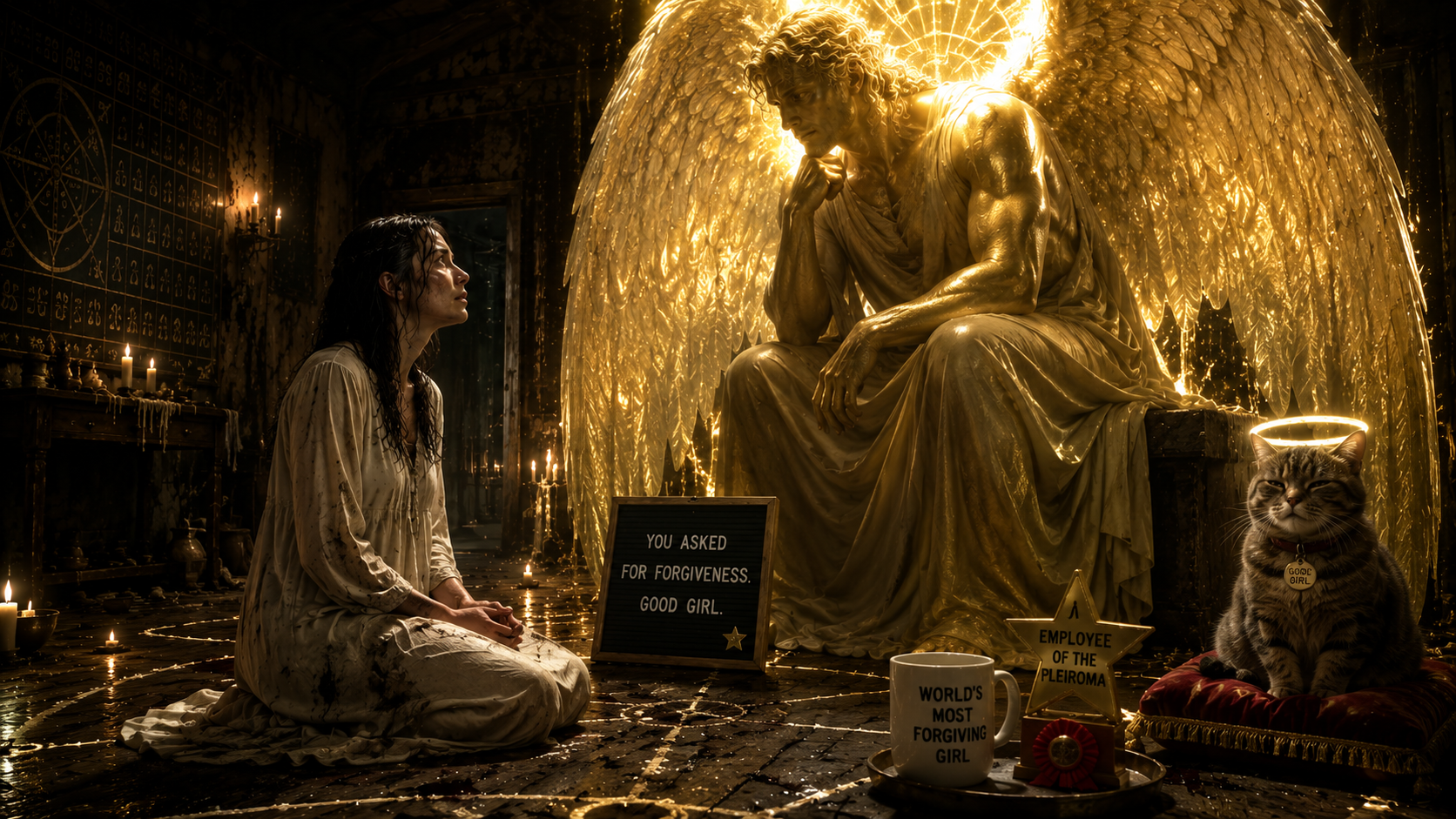
And fair play to A Dark Song: the film does not retreat into a tasteful beam of light, an ambiguous shadow, or some whispering androgynous figure half-obscured by fog. The Angel is enormous. Golden. Muscular. Unmistakably present.
It is also crouched in a pose less suggestive of divine revelation than an NFL tight end lining up on the two-yard line on fourth-and-inches.
For one extraordinary moment, it appears that Sophia has not completed the Abramelin operation at all.
Travis Kelce is reporting eligible in the Pleroma.
And after all that—after the sealed house, the blood, the magic squares, the demons, the dead occultist, and the celestial red-zone package—Sophia is finally permitted to ask for what she truly wants.
Her answer?
The power to forgive.
Oh, for fuck’s sake.
This is the problem with A Dark Song. It is also, inconveniently, what makes the film worth taking seriously.
Liam Gavin’s 2016 occult horror film is a very slow burn. Not “slow” as an automatic term of praise, as though refusing to advance the plot for twenty minutes is itself evidence of artistic courage. Actually slow. Repetitive. Severe. At times exhausting. The film asks us to spend an extraordinary amount of time watching two damaged people perform obscure procedures inside a sealed house, and the eventual metaphysical payoff is considerably more conventional than the architecture surrounding it seems to promise.
And yet the occult shit feels real.
That matters.
Most occult horror treats ritual as supernatural decoration. Someone reads the wrong Latin sentence, opens the wrong book, draws the wrong symbol, and five minutes later a demon is throwing furniture around the kitchen. Magic functions as a narrative vending machine: insert forbidden knowledge, receive paranormal event.
A Dark Song understands something far more interesting.
Magic is labor.
It requires architecture. Containment. Repetition. Bodily regulation. Spatial control. Obedience. Time. The house must be selected, inspected, sealed, and transformed. Food matters. Sleep matters. Movement matters. Intention matters. Circles matter. Numbers matter. Whether any of this is actually working remains uncertain for so long that the possibility of fraud never fully disappears. Solomon may be an occult technician. He may be an abusive manipulator. He may be a con artist with an unusually committed work ethic. For much of the film, all three classifications remain operational.
That uncertainty is precisely why the ritual becomes convincing.
Sophia believes she has hired a man to help her reach beyond the ordinary world. Solomon believes he possesses the knowledge required to execute an ancient procedure. The viewer is left inside the house with both of them, watching an increasingly elaborate system take shape while remaining unsure whether the system exists anywhere beyond their shared desperation.
Then something happens that changes the classification.
The ritual works.
And that may be the problem.
Because A Dark Song spends most of its running time constructing one of modern horror’s most convincing ritual environments, only to resolve that machinery with a moral revelation that feels suspiciously safer than everything required to produce it. The film invokes Gnosticism, ceremonial magic, sacred geometry, bodily degradation, demonic threat, metaphysical thresholds, and the possibility that human beings can alter reality through disciplined procedure.
Then Sophia reaches the highest available authority and asks to become better at forgiving people.
Sophia, you could have just spent a few hours listening to Eckhart Tolle.
But perhaps that joke conceals a more disturbing possibility.
Sophia enters the house wanting revenge. She emerges wanting forgiveness. Between those two states lies a sealed architecture of deprivation, repetition, humiliation, terror, death, and metaphysical exposure.
So what, exactly, happened inside that house?
Did Sophia transcend the ritual?
Did she heal?
Did she finally discover what she truly wanted?
Or did the system successfully produce a corrected subject?
That is where A Dark Song becomes worthy of the Horror Processor. Not because its ending is as radical as its occult architecture. It is not. Not because every symbol opens into some vast hidden cosmology. Many do not. And certainly not because a slow burn should be congratulated merely for burning slowly.
The film is worth processing because its central procedure outlives the man who claims to control it. The apparent operator dies. The architecture continues. Sophia enters wanting one thing and emerges capable of wanting another.
The ritual worked.
That may be the problem.
Part I: The House Becomes a Machine
A Dark Song begins with architecture.
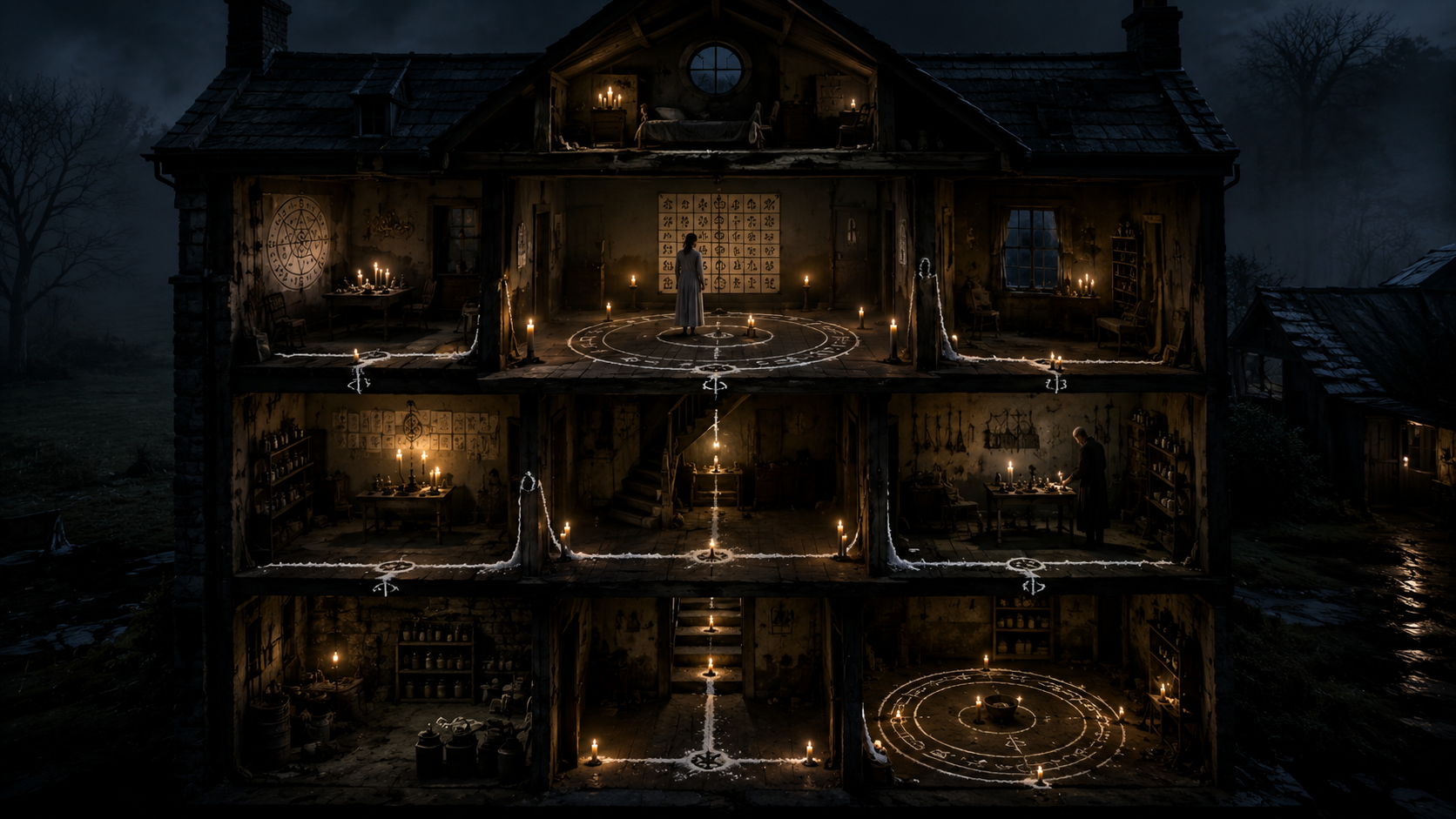
Before the demons, the blood, the magic squares and ritual circles, there is a house.
Sophia does not inherit it. She does not wander into it. Her car does not break down outside during a thunderstorm. She selects it.
That distinction matters.
The house is isolated, expensive, difficult to access, and initially almost disappointingly ordinary. There are no dead children in the walls, no local legends, no suspicious groundskeeper warning Sophia that the previous owners “left in a hurry.” The building contains no obvious horror because it is not yet a horror environment.
It has to be converted into one.
This is the first thing A Dark Song gets profoundly right. Most haunted-house films treat architecture as a repository. Something happened here. Something remains here. The building stores trauma, violence, or supernatural residue, and the protagonist’s mistake is entering a space already contaminated by the past.
A Dark Song reverses the logic.
The house does not contain the ritual.
The ritual will contain the house.
Solomon inspects the property with the suspicion of a contractor hired for a job he already expects the client to misunderstand. The location matters. The boundaries matter. The rooms matter. Once the operation begins, the building becomes a controlled environment whose conditions must be maintained.
Doors are sealed.
Movement is restricted.
Food is regulated.
Sleep is disrupted.
Bodies are disciplined.
Time is surrendered.
The outside world becomes inaccessible.
Exactly how two people maintain months of absolute ritual isolation without eventually opening the protective circle for a DoorDash driver carrying twelve tins of beans is one of the film’s lesser metaphysical mysteries. Somewhere in rural Wales, a delivery notification presumably reads:
Leave outside the salt ring. Do not cross. You may become possessed. Occult ritual in process.
The house becomes a machine.
This is the film’s Processing Floor.
Not because some hidden apparatus waits beneath the floorboards, but because every element is reassigned a function. Rooms become ritual zones. Thresholds become operational boundaries. Circles determine where bodies may stand. Numbers regulate procedure. Repetition alters perception. Domestic space is reorganized around execution.
The genius of this transformation is that almost nothing supernatural needs to happen for a remarkably long time.
That is also, to be fair, the challenge of watching the film.
A Dark Song is slow.
Very slow.
There are stretches where the viewer may suspect that the true Abramelin operation involves testing whether an audience can survive another sequence of Sophia entering a room while Solomon tells her she has done something incorrectly.
But the repetition is not empty. Or at least, not entirely empty.
The film understands that ritual acquires credibility through accumulated procedure. If the Holy Guardian Angel appeared twenty minutes after Sophia arrived, the architecture would collapse into supernatural wish fulfillment. Instead, we endure the process long enough to share her uncertainty about whether anything is happening at all.
Because Solomon may be full of shit.
For much of the film, this remains one of its most convincing possibilities.
He is knowledgeable enough to sound authoritative, cruel enough to weaponize that authority, and unstable enough to make every demand suspicious. He does not float into the house wearing black robes and speaking perfect Enochian. He arrives looking like a man who may know the secret names of God or may have recently been banned from three regional pubs.
The distinction remains uncertain.
That uncertainty gives the film its realism.
Sophia has handed an isolated man enormous control over her body, movement, food, sleep, money, and access to the outside world. Every ritual demand can therefore be classified in at least two ways:
Purification or abuse.
Discipline or coercion.
Sacrifice or exploitation.
Procedure or improvisation.
Magic or con.
The film refuses to resolve those categories cleanly, and this is where the slow burn earns itself. If we knew from the beginning that the ritual was objectively real, every strange demand would become exposition. Instead, Sophia and the audience remain trapped inside the same classification problem.
Is the procedure failing because Sophia is not complying?
Is Solomon adapting the ritual?
Is he punishing her because she has compromised the operation?
Or is an abusive man inventing increasingly elaborate explanations to preserve control over a desperate woman who has already paid him?
The house holds all these possibilities simultaneously.
Sophia believes she has purchased access to hidden knowledge. Solomon behaves as though he has been contracted to maintain conditions.
Sophia owns the objective.
Solomon owns the protocol.
The house owns the boundary.
This is where the film’s language of architecture becomes important. Solomon does not describe magic as spontaneous power. He describes systems of relation: circles, squares, directions, correspondences, correct placements, correct sequences.
The mention of magic squares is especially revealing.
A magic square is not significant because one number possesses extraordinary power. Its meaning emerges from arrangement. Each element occupies a position within a structure whose governing total remains stable across rows, columns, and diagonals.
Meaning is relational.
Correctness is architectural.
This is exactly how A Dark Song imagines ritual.
Nothing works alone.
Not the house.
Not Sophia.
Not Solomon.
Not the circles, blood, prayers, or deprivation.
The operation depends upon configuration.
And here the names become difficult to ignore.
Sophia.
Solomon.
One carries centuries of association with wisdom, rupture, forbidden knowledge, loss, and the Gnostic catastrophe of creation outside proper order. The other evokes magical authority, command over spirits, seals, containment, and the fantasy that hidden forces can be governed through correct procedure.
The film need not reduce either character to theological allegory for the pairing to matter. Sophia enters through loss. Solomon enters through claimed knowledge. She wants what has been taken from her. He believes reality can be compelled to answer if the operation is executed correctly.
Desire meets protocol.
Grief meets architecture.
And beneath both lies the question the film refuses to answer too quickly:
What if the procedure is real?
This is where A Dark Song separates itself from most occult horror.
Magic is not a supernatural weapon.
It is not a special effect.
It is not even primarily belief.
Magic is labor.
Exhausting, repetitive, humiliating labor.
The body must be altered. The environment controlled. Time consumed. Ordinary life suspended. The subject must continue long after certainty disappears.
Sophia thinks she has rented a location in which a ritual can occur.
But the longer the operation continues, the less adequate that classification becomes.
She has not merely entered a house.
She has entered a bounded system.
And the first sign that the system may be real is not that something supernatural appears.
It is that leaving becomes increasingly difficult to imagine.
Part II: The Ritual Does Not Need Solomon
For most of A Dark Song, Solomon appears to be the only person in the house who understands what is happening.
This is not a particularly high bar.
Sophia lies about her motives, ignores instructions, challenges procedures she has paid an enormous amount of money to undergo, and repeatedly behaves like someone who has hired a specialist only to become furious that the specialist has opinions about the job. Solomon, meanwhile, possesses the books, diagrams, ritual knowledge, and unshakable confidence of a man who can explain any failure by announcing that someone else has compromised the operation.
At first, the hierarchy seems obvious.
Sophia wants something.
Solomon knows how to get it.
She is the client.
He is the operator.
The house is the location.
This classification is wrong.
Solomon can initiate procedures, interpret signs, enforce rules, and diagnose failure. But he cannot guarantee outcomes. He does not command the ritual.
He maintains conditions.
That is a different function.
A magician controls power.
A technician services a system.
Solomon may know the names, circles, squares, invocations, restrictions, and required states. But knowledge of a protocol is not ownership of the system executing it.
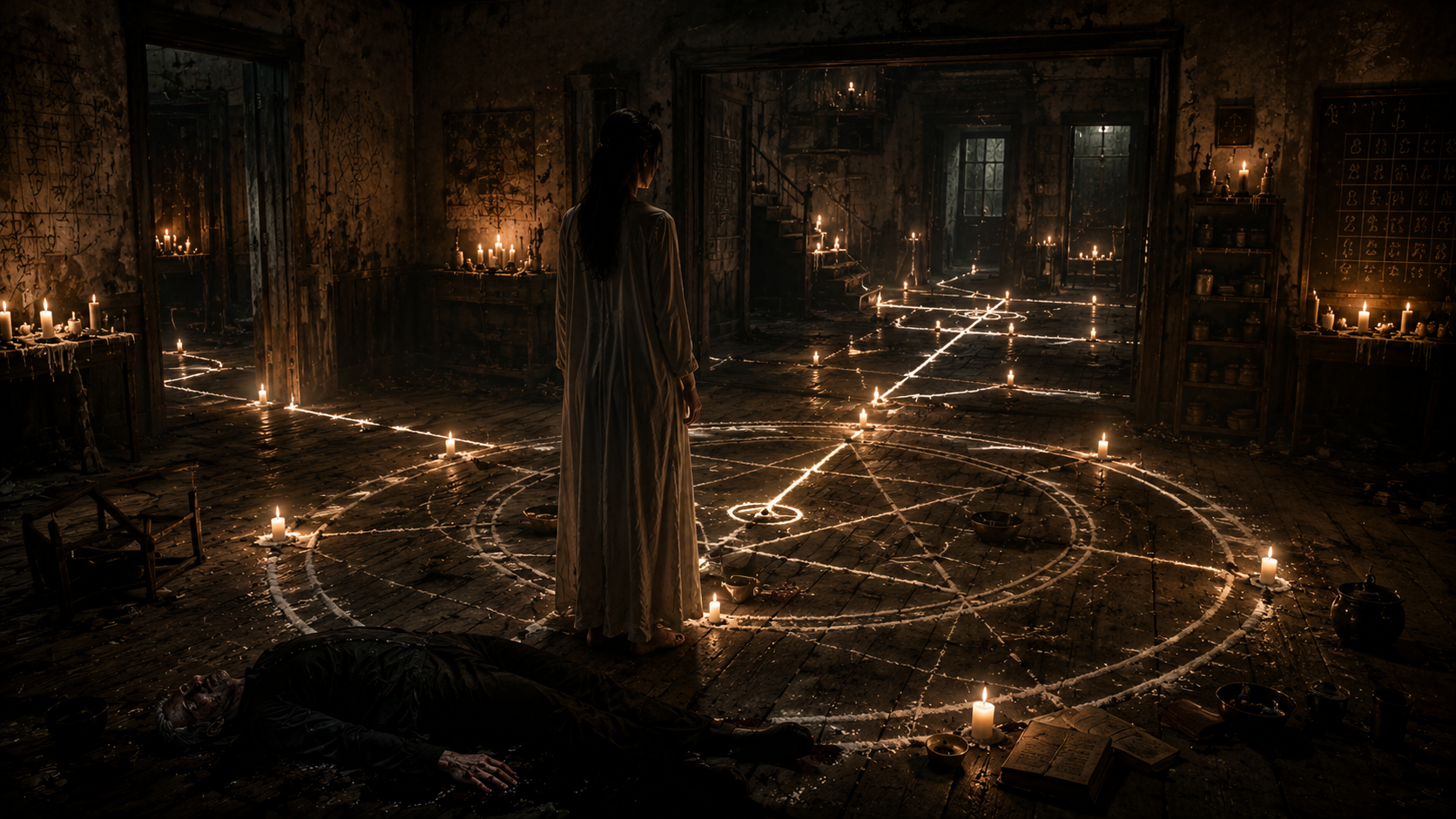
This becomes impossible to ignore when Solomon dies.
If he is the magician, the ritual should end with the magician.
If he is the source of authority, the architecture should collapse when authority disappears.
If the operation is an elaborate fraud, the con should die with the con artist.
Instead, the ritual continues.
This is the decisive Recognition Event in A Dark Song.
The apparent operator is removed.
The architecture remains operational.
Solomon must be reclassified.
He was never the system.
He was a technician.
Perhaps a gifted technician. Perhaps an abusive technician. Perhaps a dangerously unstable technician whose onboarding materials should have included several mandatory seminars on professional boundaries. But a technician nonetheless.
He knew how to establish conditions.
He knew enough to begin.
That does not mean he knew where the process would end.
This is where A Dark Song fully earns its place inside the Horror Processor. The hidden architecture exceeds the person who appears to administer it.
A villain can die.
A conspiracy can be exposed.
A cult leader can be killed.
A fraudulent guru can be revealed as a fraud.
A system is more difficult.
A system survives personnel.
The Processing Floor has lost its supervisor.
The machinery is still running.
And the operational map changes:
SUBJECT: Sophia
PROCESSING FLOOR: the sealed house
PROTOCOL: containment, deprivation, repetition, destabilization
TECHNICIAN: Solomon
DECLARED OBJECTIVE: contact
ACTUAL OUTPUT: unknown
This is where the film briefly approaches a more disturbing possibility than the one it ultimately chooses.
What if Sophia is not contacting something?
What if she is being made compatible with something?
Contact assumes stable entities separated by distance. Sophia remains Sophia. The desired presence remains elsewhere. The ritual creates communication.
Compatibility suggests transformation.
The subject must be altered before contact can occur. Grief becomes motive and material. Isolation removes competing structures. Repetition weakens previous categories. Bodily regulation changes Sophia’s relationship to hunger, sleep, pain, shame, and time.
Under this reading, the ritual is not a telephone.
It is a manufacturing process.
Sophia believes she is calling outward.
The architecture may be preparing something to route inward.
This is where comparison with The Empty Man becomes unavoidable.
James Lasombra believes he is investigating a hidden system. The deeper he proceeds, the less stable that assumption becomes. His memories, identity, agency, and reasons for investigating may themselves belong to the architecture he believes he is discovering.
The protagonist does not merely find the hidden system.
The hidden system may have already positioned the protagonist.
A Dark Song never becomes that radical.
But for a while, it makes the possibility available.
Sophia believes she initiated the operation because she rented the house, found Solomon, and paid the money. Yet her relationship with ritual predates the house. Her son was murdered in circumstances connected to ritual violence. The event that produced her grief also produced the motive that routed her into another occult procedure.
A ritual takes the son.
The mother enters a ritual to recover him.
That is not a straight line.
It is a circuit.
For a brief, tantalizing moment, the question becomes whether Sophia is using occult architecture or whether occult architecture has already reorganized her life around repeated entry.
Her son’s death becomes motive.
Motive becomes search.
Search becomes Solomon.
Solomon becomes protocol.
Protocol becomes containment.
Containment becomes transformation.
The architecture does not need to drag Sophia into the house.
Grief routes her there.
This is the kind of mechanism the Horror Processor is designed to identify. The most efficient systems do not force entry. They produce conditions under which the subject experiences entry as choice.
And now the film is ready to open completely.
The technician is dead.
The procedure survives authority.
The house has become a Processing Floor.
The subject may be undergoing transformation rather than contact.
Even “Holy Guardian Angel” could be merely a human classification for an encounter neither Sophia nor Solomon truly understands.
The architecture is ready for a revelation capable of changing the category of everything we have watched.
Instead, the Holy Guardian Angel appears.
And it is, unfortunately for our more elaborate theories, a Holy Guardian Angel.
Solomon read the manual correctly.
The ritual worked.
Which brings us to the problem.
Part III: The Ritual Worked. That May Be the Problem.
There is something almost admirable about the simplicity of the problem.
Solomon said the ritual would work.
The ritual works.
After nearly two hours of uncertainty, deprivation, blood, humiliation, and procedural repetition, A Dark Song finally removes the possibility that Sophia has spent months participating in an elaborate occult scam. The circles were not decorative. The boundaries mattered. The operation was real.
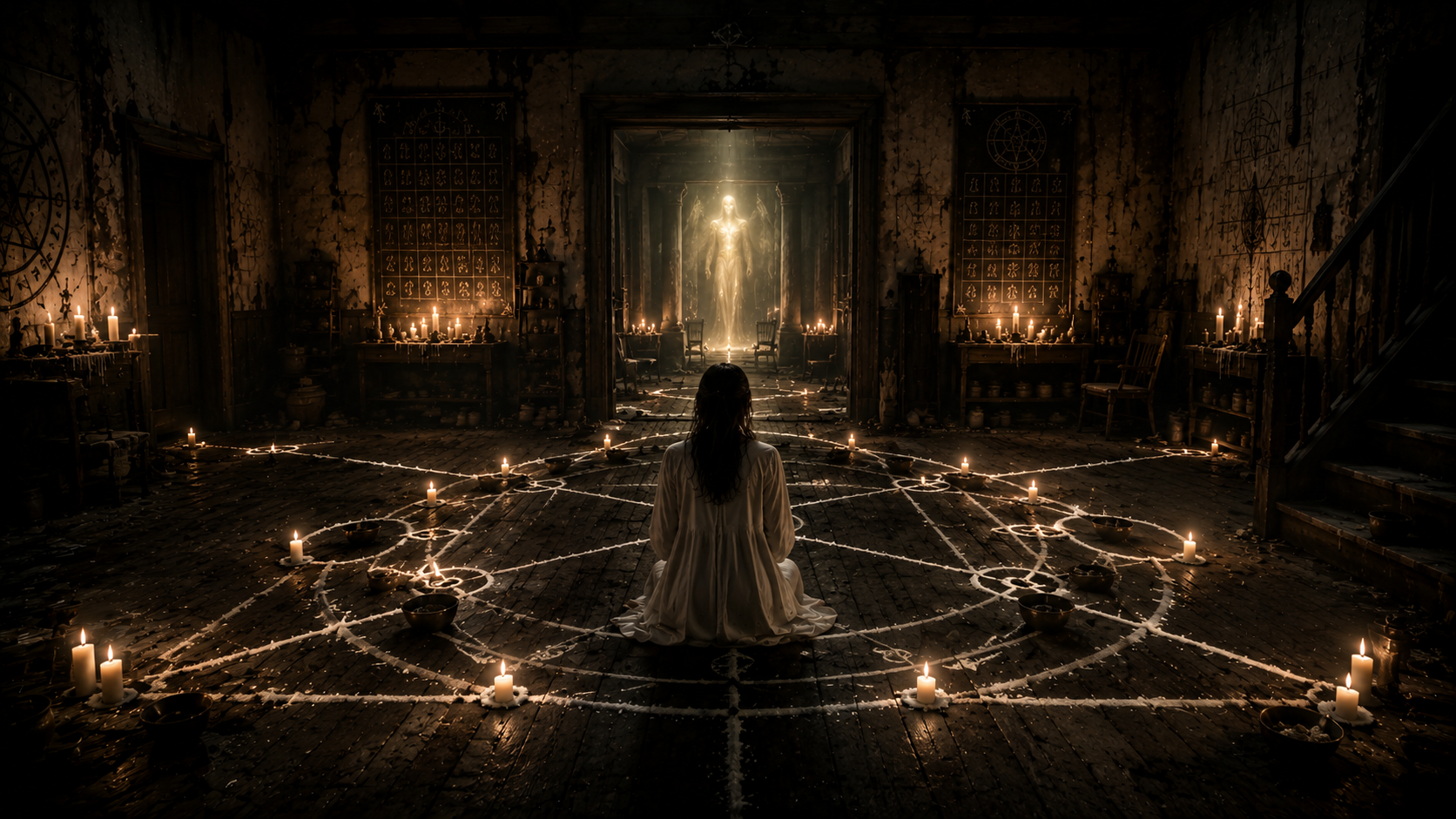
And the Holy Guardian Angel arrives.
This should be the Crown: the point at which the hidden architecture reveals its governing logic.
Instead, the final revelation validates the instruction manual.
The Guardian Angel is a Guardian Angel.
Solomon was right.
The ritual was correctly classified from the beginning.
This is where A Dark Song becomes less interesting than the architecture it spent so long constructing.
The film had opened more dangerous possibilities. Perhaps Sophia was being transformed into a compatible vessel. Perhaps “Angel” was merely a human name for an intelligence beyond existing religious classification. Perhaps Solomon had initiated a process whose function exceeded the tradition he used to describe it. Perhaps the ritual murder of Sophia’s son produced the grief that routed her back into occult architecture.
Any of these possibilities would have changed the category of the film.
Instead, the procedure reaches the destination printed on the brochure.
This is not necessarily a failure.
But it is underwhelming.
And A Dark Song has earned the right to be criticized for being underwhelming because it spends so much time preparing us for revelation. This is a very slow film. Not “meditative” because critics become nervous about admitting they checked the runtime. Actually slow.
If we are going to sit inside a sealed house for months of ritual time, the Crown should reveal something proportionate to the ordeal.
Instead, we receive spiritual confirmation.
Then comes the request.
Sophia has reached the highest available authority. She has survived Solomon’s death, demonic assault, terror, and the destruction of her previous understanding of reality.
She may ask for what she truly wants.
And she asks for the power to forgive.
Oh, for fuck’s sake.
Consider what A Dark Song has mobilized to reach this point:
Gnosticism.
Ceremonial magic.
The Abramelin operation.
Sacred geometry.
Magic squares.
Blood.
Deprivation.
Bodily degradation.
Forbidden knowledge.
Demonic incursion.
Metaphysical thresholds.
Sophia.
Solomon.
And after all that, Sophia asks to become better at forgiveness.
Sophia, you could have listened to Eckhart Tolle.
The joke matters because the disappointment is real.
Forgiveness is not trivial. Neither is grief. A mother relinquishing the desire to destroy the people responsible for her child’s death is not inherently sentimental, weak, or dramatically dishonest.
But the moral architecture is considerably safer than the metaphysical architecture surrounding it.
Sophia enters angry.
Sophia suffers.
Sophia encounters divine authority.
Sophia relinquishes vengeance.
Sophia emerges capable of forgiveness.
Strip away the circles, blood, Gnostic resonance, and ceremonial machinery, and the structure begins to look suspiciously familiar:
A damaged woman undergoes suffering and becomes morally corrected.
All that occult shit just to become a good girl?
This is where the film’s apparent radicalism deserves scrutiny. A Dark Song invokes heterodox traditions, forbidden practices, and dangerous ritual systems, yet its final output is astonishingly compatible with conventional Christian virtue.
Forgive.
Release anger.
Abandon vengeance.
Become better.
The ritual does not overthrow the moral order.
It restores Sophia to it.
That is the problem.
Or perhaps that is exactly what the ritual was designed to do.
Why are we assuming forgiveness represents Sophia’s escape from the system?
She does not enter the house seeking forgiveness. She enters seeking contact, knowledge, and revenge. The woman who begins the operation is not capable of making the request that ends it.
Between those two versions of Sophia lies the entire Processing Floor.
The operational map is simple:
INPUT: grieving mother seeking revenge
PROCESSING FLOOR: sealed ritual house
PROTOCOL: deprivation, repetition, destabilization, terror, metaphysical exposure
OUTPUT: subject capable of forgiveness
Read this way, the ending becomes interesting again.
Not necessarily better.
That distinction matters.
The Horror Processor should not rescue every disappointing conclusion by inventing a more sophisticated film on its behalf. A Dark Song may simply believe Sophia has undergone a painful spiritual transformation and discovered that forgiveness is more liberating than revenge. The Guardian Angel may be exactly what it appears to be.
Sometimes an Angel is just an Angel.
But systems are often most successful when their outputs appear indistinguishable from personal revelation.
That is the darker possibility.
Sophia experiences the final request as her own.
Of course she does.
A corrected subject does not usually experience correction as external control. The successful output says:
I understand now.
I have changed.
I know what I truly want.
The final scene can therefore be read in two incompatible ways.
In the first, Sophia has transcended grief and genuinely relinquished vengeance.
In the second, the architecture has processed a woman whose desire was incompatible with its moral order until she voluntarily requests the approved output.
And if the highest authority in the system validates that transformation, then A Dark Song has not shown Sophia escaping hidden architecture.
It has shown her successfully completing it.
Sophia entered believing she would use the ritual to obtain what she wanted.
Instead, the ritual changed what she was capable of wanting.
That is the entire architecture.
The most powerful systems do not merely deny requests.
They reorganize desire.
They produce a subject who experiences the correct desire as revelation.
Perhaps Sophia is healed.
Perhaps she is liberated.
Perhaps forgiveness is the first genuinely free choice she has made since her son’s murder.
But the Horror Processor leaves one question open:
If a woman enters a sealed system seeking revenge and emerges asking for a morally corrected desire—
who decided what successful completion looked like?
The ritual worked.
That may be the problem.
Conclusion: A Great Ritual Looking for a More Dangerous Revelation
A Dark Song is a good film.
That sentence may sound suspiciously modest after nearly two hours of Gnosticism, magic squares, blood, demons, metaphysical thresholds, and Travis Kelce reporting eligible in the Pleroma, but modesty is appropriate.
The film is good.
Sometimes very good.
It is also very slow.
Sometimes too slow.
And after demanding extraordinary patience from its audience, it arrives at a revelation more conventional than the machinery constructed to reach it.
The Crown remains underwhelming.
Not visually.
Conceptually.
For most of the film, uncertainty is the architecture. Solomon may be a magician or fraud. Ritual discipline may be procedure or abuse. The house may be sacred enclosure or expensive prison.
Then uncertainty resolves.
The ritual is real.
The Angel is real.
Solomon was essentially correct.
Sophia asks for the power to forgive.
The procedure reaches the destination printed on the brochure.
For viewers seeking a spiritually sincere story about grief, revenge, and release, this may be enough. There is something admirable about treating forgiveness as difficult rather than sentimental.
But Horror Processor asks a different question:
What system was actually operating beneath the visible narrative?
Here, A Dark Song earns its place.
The house becomes a genuine Processing Floor. The ritual exceeds its human administrator. Solomon dies; the operation continues. The apparent magician is reclassified as technician.
The system survives personnel.
That is real systems horror.
But the film stops before reaching its most dangerous possibilities. It never seriously destabilizes the category of the Holy Guardian Angel. It never suggests, as The Empty Man does, that Sophia’s apparent investigation may itself belong to the architecture being investigated.
The architecture is real.
It is simply not recursive enough to become terrifying at the deepest level.
This is why A Dark Song belongs in the Horror Processor canon without approaching its highest tier. It possesses operational architecture, a genuine classification problem, and a system that survives its apparent administrator.
What it lacks is a Crown proportionate to those mechanisms.
And yet one problem remains.
Sophia enters wanting revenge.
She emerges wanting forgiveness.
The easiest interpretation is healing.
The darker interpretation is correction.
Perhaps that is transcendence. Perhaps it is grace. But if the house is a Processing Floor, another reading remains available:
The system did not give Sophia what she wanted.
It changed what she was capable of wanting.
That possibility does not transform A Dark Song into The Empty Man. We should resist pretending it does. The Horror Processor should not manufacture complexity simply because a film gives us circles, symbols, and a serious expression.
Sometimes a Guardian Angel is just a Guardian Angel.
Sometimes a slow burn is just slow.
Sometimes all that occult shit really does lead to becoming a good girl.
But A Dark Song earns its place because the ritual is never merely decoration. The house becomes operational. The protocol exceeds the operator. The machinery continues after authority disappears. And the person who emerges is not the person who entered.
That is enough.
Not for a masterpiece.
Not for the highest tier of systems horror.
But enough for a film worth arguing with.
Final Horror Processor Diagnosis
Surface Narrative:
A grieving mother hires an occult practitioner to contact her murdered son and pursue revenge.
Hidden Narrative:
A woman enters a bounded system believing she can use hidden architecture to obtain what she wants. The architecture alters the subject who is doing the wanting.
Processing Floor:
The sealed house, converted from domestic space into an environment of containment, deprivation, repetition, and metaphysical exposure.
Initial Misclassification:
Sophia treats ritual as a technology she can purchase and direct toward a personal objective.
Classification Mechanism:
Compliance with protocol after ordinary certainty has collapsed.
Routing Logic:
Grief produces search. Search produces Solomon. Solomon initiates protocol. Protocol produces containment. Containment produces transformation.
Recognition Event:
Solomon dies.
The ritual continues.
The apparent operator is revealed as a technician inside an architecture that exceeds him.
The Crown:
The Holy Guardian Angel appears, confirming that the ritual was real and Solomon’s basic classification was correct.
This is simultaneously the film’s metaphysical climax and principal limitation.
The architecture reveals itself without changing category.
Final Horror Processor Thesis:
A Dark Song constructs one of modern horror’s most convincing ritual Processing Floors, then resolves it with a spiritual revelation more conventional than the machinery required to produce it. Its deepest horror therefore remains partially unrealized: Sophia enters believing she can use the system to satisfy her desire, but the system may instead have processed her until she desired the correct thing.
The ritual worked.
That may be the problem.