Cure (1997): The World's Worst Therapist: The Process That Modern Psychology Couldn't Erase
Every therapist has difficult patients.
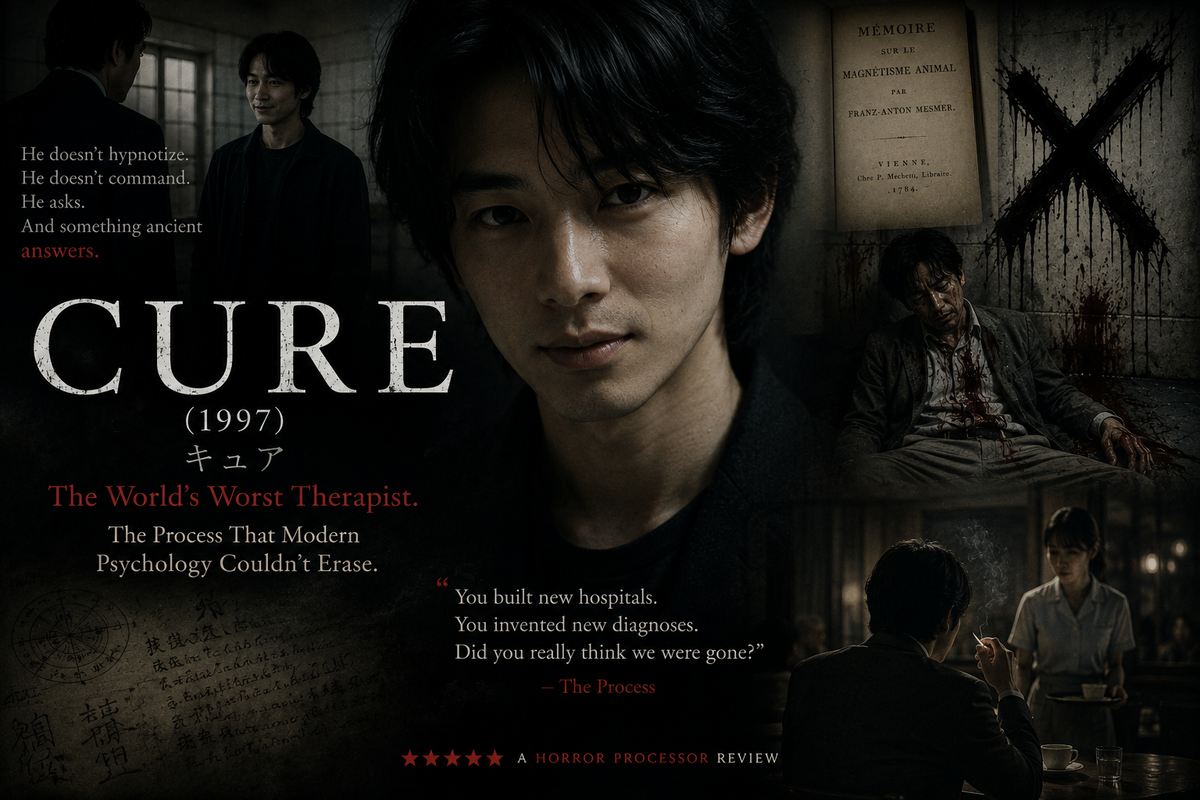
Mamiya's patients generally leave the session and begin enthusiastically bludgeoning strangers with lengths of galvanized pipe, carving enormous Xs into walls, or peeling another human being's face off in broad daylight.
By any reasonable clinical standard, his treatment outcomes are disappointing.
In fairness to Mamiya, his therapeutic approach is refreshingly straightforward. He doesn't rely on expensive self-help seminars, personality assessments, or mindfulness retreats. He simply asks a few deceptively ordinary questions.
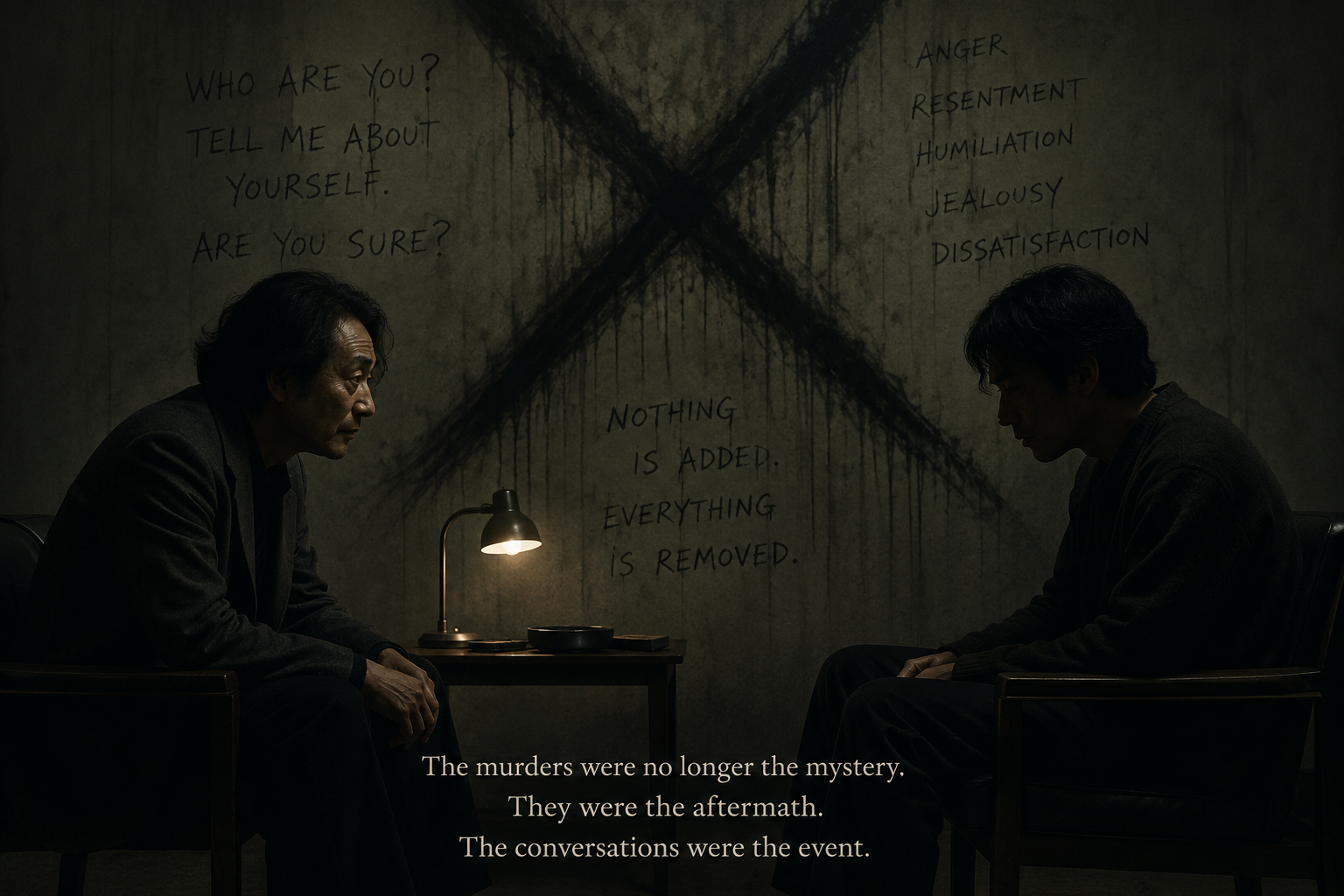
"Who are you?"
"Tell me about yourself."
"Are you sure?"
A few minutes later, someone's life has collapsed in spectacular fashion.
It is, objectively speaking, a terrible business model.
Which raises an awkward question.
The film isn't called Disease.
It isn't called Hypnosis.
It isn't even called The X Murders.
It's called Cure.
That title sat quietly in the back of my mind throughout the entire film, becoming stranger every time another therapy session ended in catastrophic violence.
The strange thing is that the longer I watched Cure, the less interested I became in the murders.
Instead, I became fascinated by the conversations.
At first, I thought I was watching a detective story. Detective Takabe investigates a series of bizarre murders connected by an identical X-shaped wound. Every killer appears ordinary, remembers almost nothing, and has no obvious motive. Somewhere behind them must be a mastermind. A serial killer. A hypnotist. Someone.
Then the film quietly shifts my attention.
Dr. Sakuma enters the story as the voice of modern psychology. Like Takabe, I assumed he would eventually explain the mystery.
He doesn't.
The closer Sakuma comes to understanding Mamiya, the less capable he becomes of explaining him.
That was the moment I realized I had been asking the wrong question.
For most of the film, I kept asking:
Who is Mamiya?
By the end, I was asking something entirely different.
What function does he perform?
That shift became far more interesting to me than the identity of the killer.
So let's begin where every terrible therapy session begins.
"Tell me about yourself."
Part I: "Tell Me About Yourself."
The first time Mamiya asks someone, "Who are you?" it feels strangely ordinary.
There are no elaborate hypnosis rituals. No occult symbols. No booming speeches about the hidden nature of reality. If anything, Mamiya appears confused, fragile, and almost incapable of functioning without assistance. He forgets his own name, loses his train of thought, and asks the same questions over and over again.
Most people respond exactly as you would expect.
They try to help him.
That's what makes Mamiya so unsettling.
Unlike most cinematic predators, Mamiya doesn't approach his victims from a position of strength but of apparent weakness. He doesn't demand attention; he quietly receives it. The people around him instinctively become caretakers, answering his questions and trying to reconstruct his identity.
It is an extraordinary disguise.
The more I thought about it, the less Mamiya resembled a serial killer and the more he resembled a therapist conducting an intake interview.
"Tell me about yourself."
"What kind of person are you?"
"Are you sure?"
Those are perfectly reasonable therapeutic questions.
Unfortunately, Mamiya's treatment outcomes remain difficult to recommend.
Most therapists spend years helping patients construct a healthier sense of self.
Mamiya appears committed to dismantling one before lunch.
The brilliance of Cure is that it never presents these conversations as dramatic confrontations. They unfold with almost unbearable calmness. Long pauses. Soft voices. Simple questions. Nothing outwardly threatening happens, yet by the end of each conversation something fundamental has shifted. The murders feel less like isolated acts of violence than the delayed consequence of a process already set in motion.
This is where Cure quietly separates itself from conventional psychological horror.
Most films of this kind invite us to ask what Mamiya is doing to people.
Kurosawa asks a more unsettling question.
What if Mamiya isn't putting anything into them at all?
What if he's removing something?
The film repeatedly hints that the violence isn't manufactured during these encounters. Anger, resentment, humiliation, jealousy, dissatisfaction—those emotions already exist. Mamiya never lectures anyone into adopting them. He simply asks deceptively ordinary questions until the stories people tell themselves about who they are begin to fracture.
The murders were no longer the mystery.
They were the aftermath.
The conversations were the event.
If Mamiya isn't putting something into people...
what exactly is he trying to cure?
Part II: Sakuma and the Failure of Modern Psychology
Every detective story eventually reaches the same moment.
The detective gathers enough evidence to consult an expert.
The expert explains the mystery.
The audience nods in satisfaction.
The investigation continues.
Cure quietly refuses to cooperate.
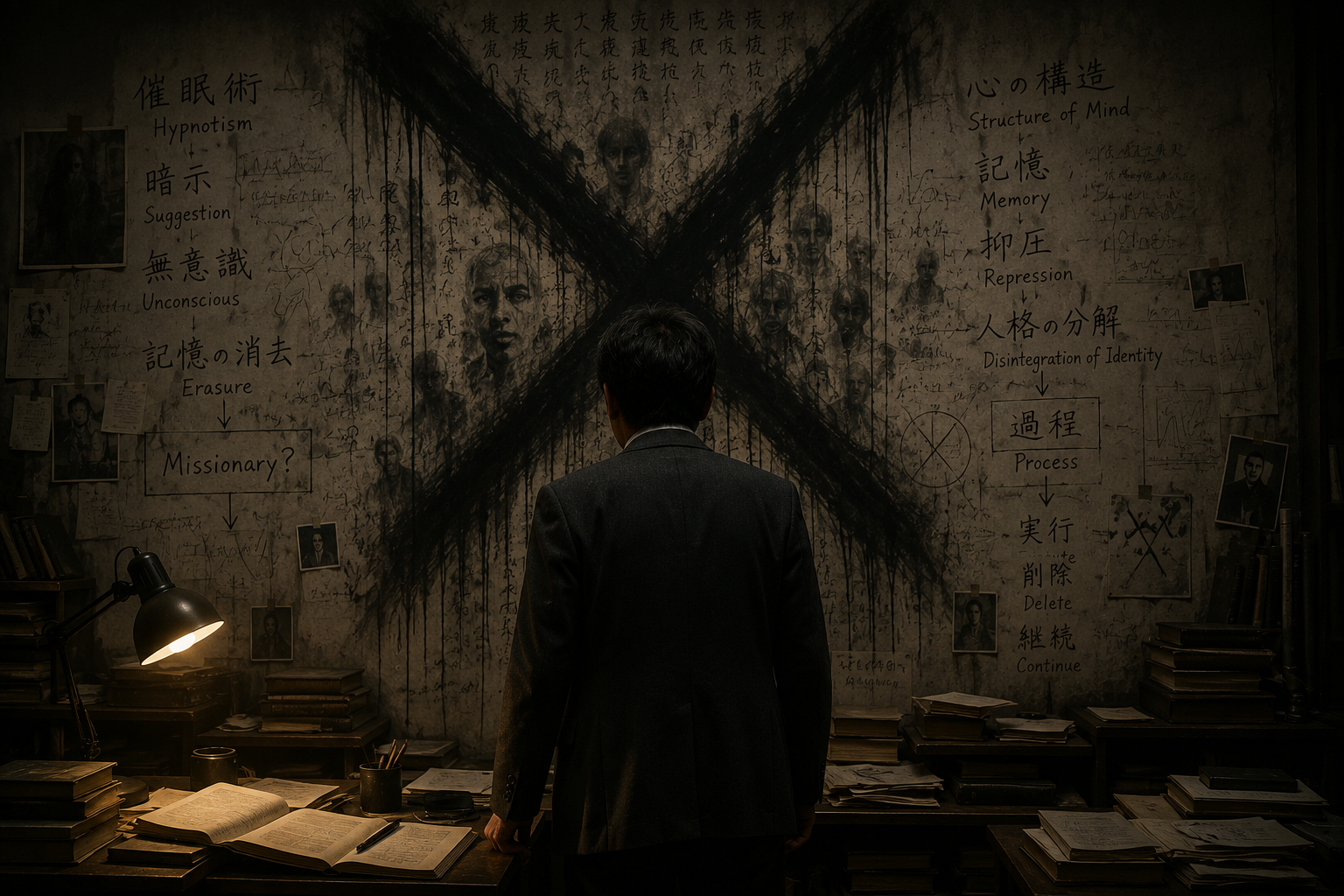
Dr. Sakuma enters the film as exactly the character we expect to solve the puzzle. If Detective Takabe represents investigation, Sakuma represents explanation. When the murders begin resisting ordinary psychology, he digs into mesmerism, forgotten theories, and the history of hypnosis.
For a while, it feels as though we're finally getting somewhere.
Then something remarkable happens.
The more Sakuma learns, the less capable he becomes of explaining anything.
His research doesn't strengthen his confidence.
It dismantles it.
One of the film's most fascinating moments arrives almost casually. While discussing Mamiya, Sakuma reaches for a curious word.
Missionary.
Not hypnotist.
Not serial killer.
Not psychopath.
Missionary.
A missionary doesn't simply spread information.
He carries a belief.
A system.
A way of understanding the world.
Whether Kurosawa intended that implication or not, I found it difficult to ignore. The closer Sakuma comes to understanding Mamiya, the less Mamiya resembles a criminal and the more he resembles the carrier of something much older than himself.
Then Sakuma's own world begins to collapse.
The giant X consuming his wall feels less like another disturbing image than the moment his explanatory framework finally gives way. Shortly afterward, Sakuma's apparent suicide marks the collapse of the film's final confident explanatory voice.
That isn't simply another gruesome death.
It's the collapse of the film's final confident explanatory voice.
By this point, Takabe cannot explain Mamiya.
Now Sakuma cannot explain him either.
The detective has reached the limits of investigation.
The psychologist has reached the limits of explanation.
The audience is left asking not who Mamiya is...
but what he is.
Notice what the film keeps doing.
Every time we think we've reached the deepest explanation, Kurosawa quietly walks us backward another step.
Modern criminal investigation.
Modern psychiatry.
Historical psychology.
Mesmerism.
Forgotten institutions.
The film isn't merely telling a mystery.
It's excavating older layers of thought.
That's why Sakuma's failure matters.
The tragedy isn't that he lacks knowledge.
It's that he finally encounters something his knowledge no longer seems capable of describing.
By the end of his investigation, I no longer felt that I was watching psychology confront mental illness.
I felt as though I was watching modern psychology stumble into an older process it had long ago forgotten how to name.
Scene III: The Forgotten Process
By the time Cure reaches its final act, I no longer felt like I was watching a detective story.
I felt like I was watching an archaeological excavation.
Every layer the film uncovers seems older than the one before it.
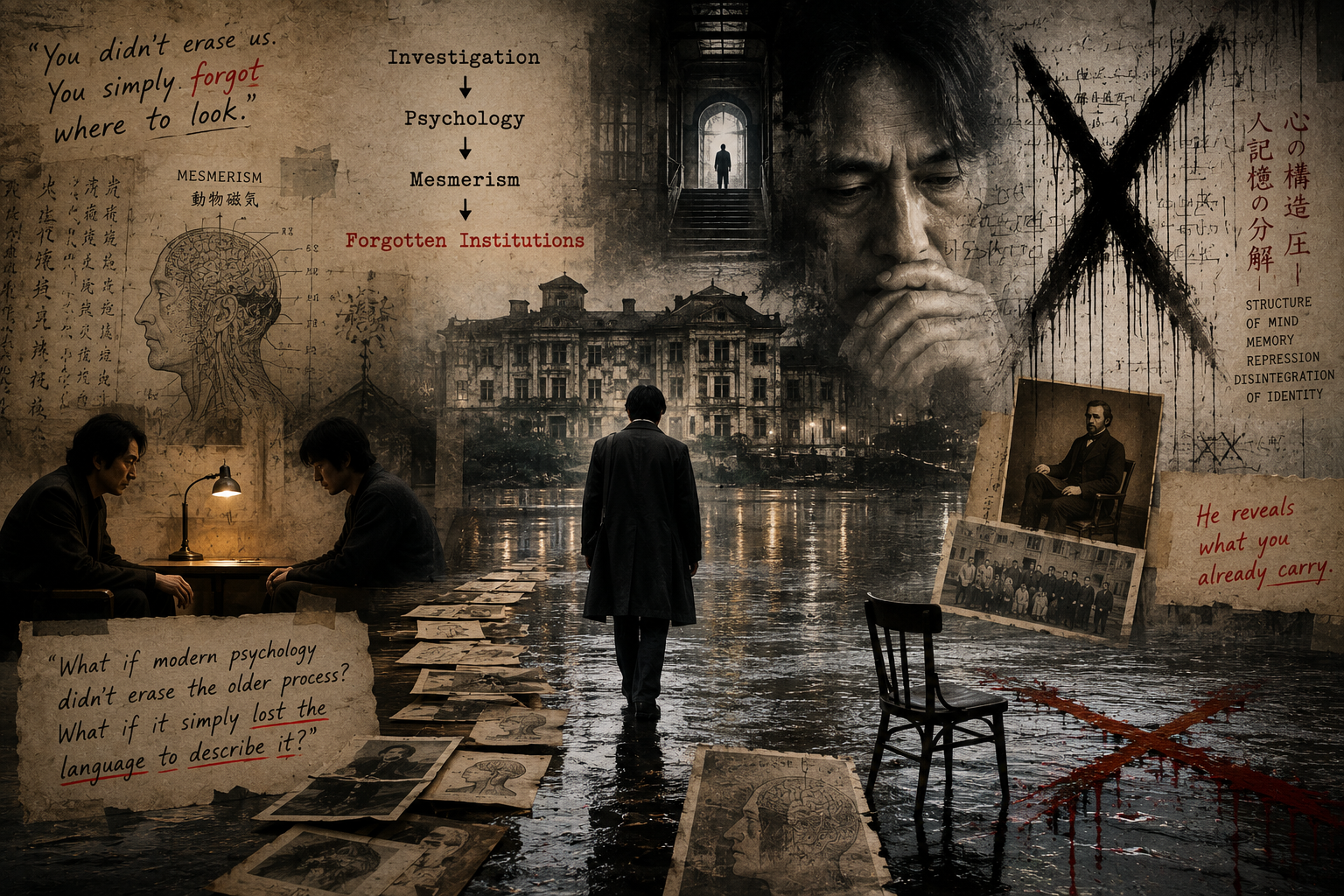
The police investigation gives way to psychology.
Psychology gives way to mesmerism.
Mesmerism gives way to forgotten institutions.
Rather than uncovering a final explanation, Cure keeps digging.
Backward.
The deeper Takabe descends, the less interested the film becomes in solving the murders and the more interested it becomes in exposing the limits of the systems attempting to explain them.
That was the moment another possibility occurred to me.
What if Mamiya isn't spreading a new idea?
What if he's carrying an old one?
Not ancient in the supernatural sense.
Ancient in the sense that modern civilization quietly decided it had outgrown it.
Perhaps that's why Sakuma's research feels so significant.
He isn't discovering something unprecedented.
He's rediscovering something history gradually stopped talking about.
I don't think Cure argues that mesmerism was scientifically correct or that forgotten psychological theories should replace modern psychiatry.
Its question feels far more unsettling.
What if modern psychology didn't erase the older process?
What if it simply lost the language to describe it?
That possibility transforms Mamiya.
He no longer resembles a magician.
Or even a villain.
He begins to resemble the visible expression of something that has continued operating beneath history.
Which brings me back to the title.
Not The Cure.
Simply...
Cure.
Cure for what?
Every person Mamiya encounters appears psychologically intact on the surface, yet each already carries resentment, dissatisfaction, grief, shame, anger, or despair beneath a carefully maintained identity.
Mamiya doesn't seem to implant those emotions.
He reveals them.
If that's true, the title becomes deeply uncomfortable.
What if Mamiya doesn't believe he's spreading a disease?
What if he believes he's administering the cure?
Not our cure.
His.
Perhaps that's why he remains so calm throughout the film.
He never behaves like a man delighting in cruelty.
He behaves like someone carrying out a procedure.
Imagine an older process quietly whispering beneath modern civilization.
"You built new hospitals."
"You wrote new textbooks."
"You invented new diagnoses."
"Did you really think we were gone?"
"You didn't erase us."
"You simply forgot where to look."
Whether that's what Cure ultimately means is impossible to say with certainty.
But by the time the credits rolled, I wasn't thinking about hypnosis.
Or serial killers.
Or even Mamiya.
I was thinking about processes.
Processes that survive the people who carry them.
Processes that outlive the institutions trying to explain them.
Processes that quietly continue...
long after everyone assumes they have disappeared.
Conclusion: The World's Worst Therapist?
The final scene of Cure is one of those endings that quietly refuses to leave your mind.
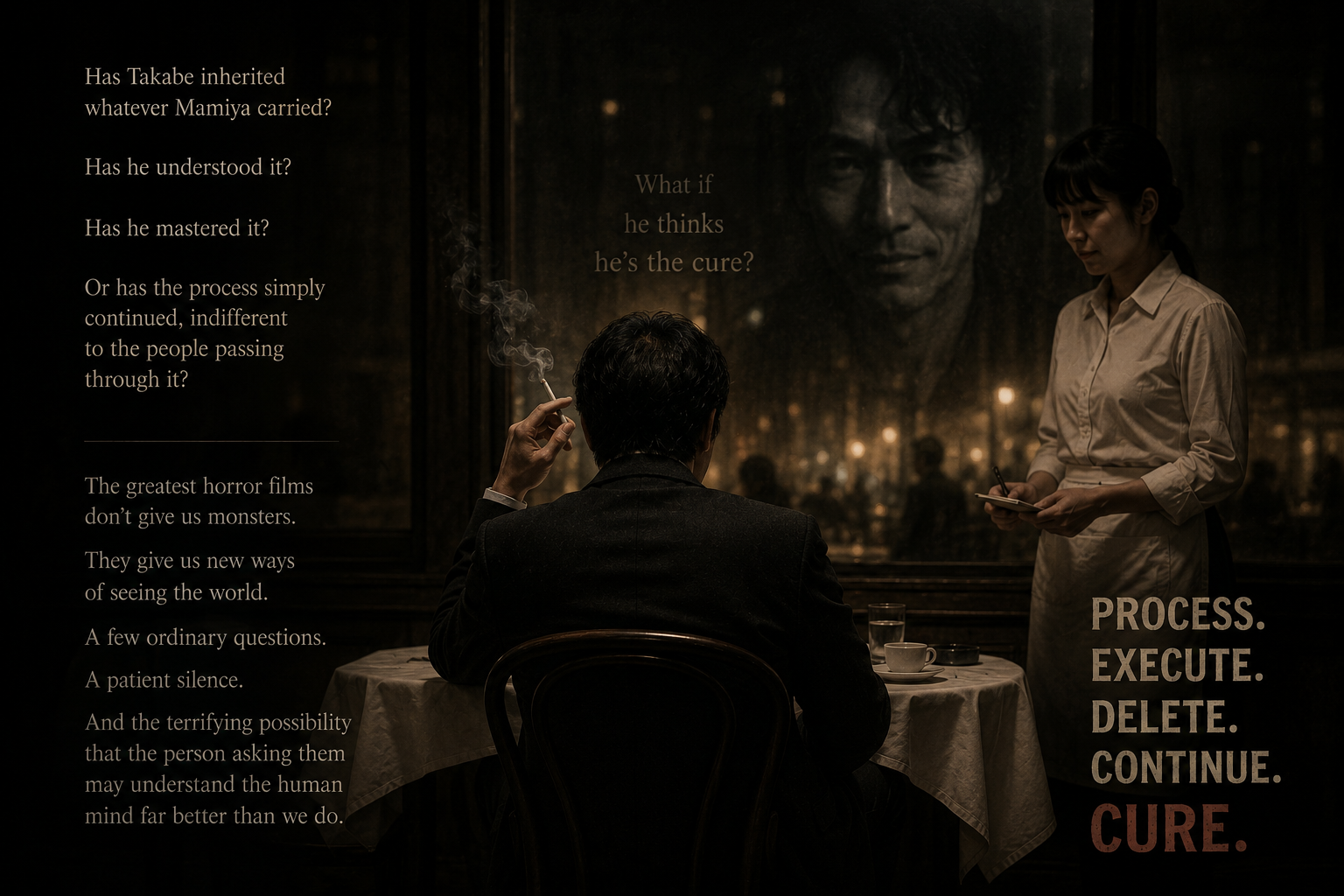
Detective Takabe no longer looks like the exhausted investigator we've followed throughout the film. He appears calmer. Better dressed. More composed.
Then he lights a cigarette.
A waitress approaches.
The conversation is brief.
Ordinary.
Almost forgettable.
Until it isn't.
Kurosawa cuts away before we receive the satisfaction of certainty, leaving only implication.
Has Takabe inherited whatever Mamiya carried?
Has he understood it?
Has he mastered it?
Or has the process simply continued, indifferent to the people passing through it?
I don't think the film wants us to answer those questions.
I think it wants us to keep asking them.
That's what great psychological horror does.
It doesn't merely frighten us.
It quietly changes the questions we ask.
When I began Cure, I wanted to know who the killer was.
By the end, I wanted to know what Mamiya was.
Now I find myself asking something even stranger.
What exactly is the cure?
Throughout the film, I assumed Mamiya was spreading a sickness.
But what if that assumption belongs to me rather than to him?
Mamiya never behaves like a man celebrating chaos.
He never gloats.
He never rages.
He never delights in suffering.
He calmly asks questions.
He waits.
He listens.
Everything about his behavior suggests someone carrying out a procedure rather than pursuing a revenge fantasy.
Which makes the final question almost impossible to ignore.
We called him the world's worst therapist because every one of his sessions seems to end in unimaginable violence.
But what if we've been judging him by the wrong therapeutic outcome?
What if Mamiya isn't trying to preserve identity?
What if he's trying to dismantle it?
What if repression, memory, morality, and the fragile stories we tell ourselves about who we are constitute the illness?
What if everything that follows is, from his perspective...
the cure?
I don't know.
I don't think Cure wants me to know.
And that's precisely why I haven't stopped thinking about it.
The greatest horror films don't simply give us monsters.
They give us new ways of seeing the world.
Nearly thirty years after its release, Cure still possesses that rare ability to quietly destabilize the assumptions we bring into it.
Not through spectacle.
Not through jump scares.
Not through elaborate mythology.
Through conversation.
A few ordinary questions.
A patient silence.
And the terrifying possibility that the person asking them may understand the human mind far better than we do.
So perhaps our running joke deserves one final revision.
Maybe Mamiya isn't the world's worst therapist.
Maybe...
he thinks he's the best.
PROCESS.
EXECUTE.
DELETE.
CONTINUE.
CURE.