KILL LIST (2011): COMPATIBILITY TESTING
INTRODUCTION: THE WRONG SUPERLATIVE
The reviews frequently describe Kill List as one of the most frightening hitman films ever made.
The Horror Processor does not entirely agree with this assessment.
This is not because the film lacks disturbing imagery, violence, dread, or psychological intensity. It possesses all of these in abundance.
The problem is the word frightening.
Frightening suggests a specific type of experience.
A threat.
A danger.
A killer.
A pursuit.
Something immediate.
Something the audience can recognize.
Kill List is interested in something stranger.
The Processor initially classified the film as Standard Hitman Infrastructure™.
Two former soldiers.
Financial difficulties.
Marital instability.
Contract killings.
Known workflow.
Documentation complete.
Case closed.
The case was not closed.
A symbol appears.
A witness behaves incorrectly.
A victim expresses gratitude.
Several people seem to possess information they should not possess.
The hitman explanation remains operational, but its performance metrics begin declining rapidly.
This is where Horror Processor became interested.
Not because the film became frightening.
Because the explanation stopped explaining.
For much of its runtime, Kill List creates the impression that the audience is uncovering a conspiracy alongside its protagonist.
This is a familiar horror structure.
A man discovers something terrible.
A man becomes outraged.
A man decides to fight the system responsible.
The Processor initially assumed this was the film's trajectory.
The Processor was incorrect.
By the conclusion, Kill List reveals itself to be operating according to a logic fundamentally different from the one the audience initially accepted.
The Processor initially classified the film as Standard Hitman Infrastructure™.
The film appears to have classified itself as something else entirely.
The hitman narrative remains present.
But it is no longer the deepest layer.
Something older appears to be operating beneath it.
Something procedural.
Something ritualized.
Something less interested in murder than in selection.
This is what ultimately separates Kill List from more conventional conspiracy horror.
Most conspiracy horror asks whether a hidden system exists.
Kill List asks a far more disturbing question:
What if the hidden system already knows how you will respond to discovering it?
For Horror Processor purposes, this is where the true horror begins.
Not when people die.
Not when the conspiracy is revealed.
But when the audience begins to suspect that the protagonist's rebellion may not be disrupting the architecture at all.
It may be completing it.
The audience believes Jay is moving toward resistance.
The architecture appears to believe he is moving toward compatibility.
And that possibility transforms Kill List from a frightening hitman film into something much stranger.
The realization that you have not been watching a man uncover a hidden system.
You have been watching a hidden system process a man.
SECTION I: THE LIBRARIAN
Or, The Processing Floor
Every Horror Processor film eventually arrives at a moment when the current explanation stops working.
In Kill List, that moment arrives in a library.
The Processor initially approved this development.
Librarians maintain archives.
Archives imply infrastructure.
Infrastructure generally implies hidden architecture.
This is usually promising.
At first, however, the scene appears considerably less sophisticated than expected.
The target is known as The Librarian.
The audience naturally assumes the title is metaphorical.
Perhaps he maintains records.
Perhaps he archives information.
Perhaps he possesses knowledge dangerous enough to require elimination.
Instead, the film presents shelves and shelves of pornography.
For a brief moment, the audience relaxes.
The explanation still explains.
Criminals are killing criminals.
The target is a deviant.
The job remains a job.
Case closed.
The case was not closed.
The Processor notices a discrepancy.
The library is too small.
This is a strange observation, but an important one.
Professional degeneracy should possess scale.
The collection feels incomplete.
Curated.
Selective.
Less like a business.
More like an archive.
The audience may not consciously recognize the anomaly, but the film quietly plants it anyway.
Something is missing.
Then the film arrives.
And the explanation collapses.
The audience does not need to see much.
Jay does not need to explain what he is seeing.
The film understands a principle previously demonstrated by True Detective.
Certain images do not require exposition.
The reaction is sufficient.
We know.
Jay knows.
The Processor knows.
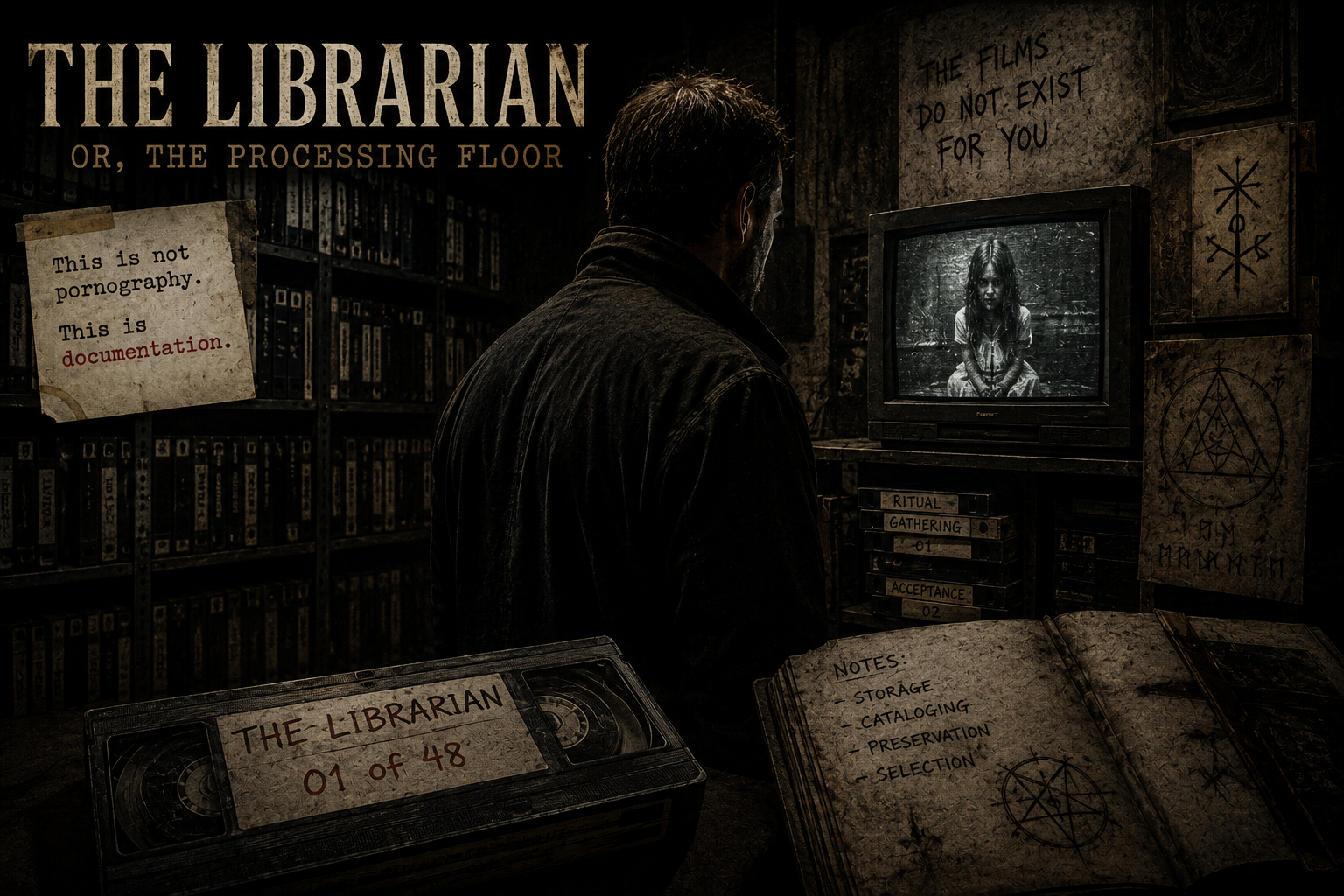
This is not pornography.
This is documentation.
The distinction is significant.
Pornography asks to be watched.
Documentation asks to be remembered.
What The Librarian possesses is not merely a collection of illicit material.
It is an archive.
A record.
Evidence that something larger exists beyond the room itself.
This is the moment Kill List stops functioning as a hitman film.
Not because the violence changes.
Because the architecture changes.
The films serve the same function as the videotapes in True Detective.
They are not the horror.
They are the notification.
SYSTEM MESSAGE:
Current explanation incomplete.
Additional architecture detected.
At this point, Jay responds exactly as the audience expects.
Rage.
Disgust.
Violence.
The Processor initially classified this reaction as heroic.
After all, this is the traditional structure.
A man discovers unimaginable evil.
A man decides to destroy unimaginable evil.
Case closed.
Kill List is not interested in heroism.
Kill List is interested in compatibility.
This is where the scene becomes considerably more disturbing.
Because the films are not merely revealing the system.
They are revealing Jay to the system.
The audience assumes Jay has discovered the processing floor.
The film eventually suggests something much stranger.
The processing floor may have been waiting for him.
The films are not simply evidence.
They are an evaluation metric.
The audience sees a man discovering evil.
The architecture sees a candidate responding to stimulus.
This is the first indication that the hidden system may not be concerned with the people appearing on the screen.
It may be concerned with the man watching them.
Jay believes he is looking at the architecture.
The architecture may already be reviewing his application.
SECTION II: THE THANK YOU
Or, Compatibility Testing
If The Librarian reveals the existence of a hidden architecture, the next sequence reveals something considerably more disturbing.
The architecture already knows Jay exists.
At first, the anomaly appears insignificant.
A strange expression.
An unusual reaction.
A victim behaving incorrectly.
The Processor initially classified these moments as atmospheric irregularities.
Then they continued.
And continued.
And continued.
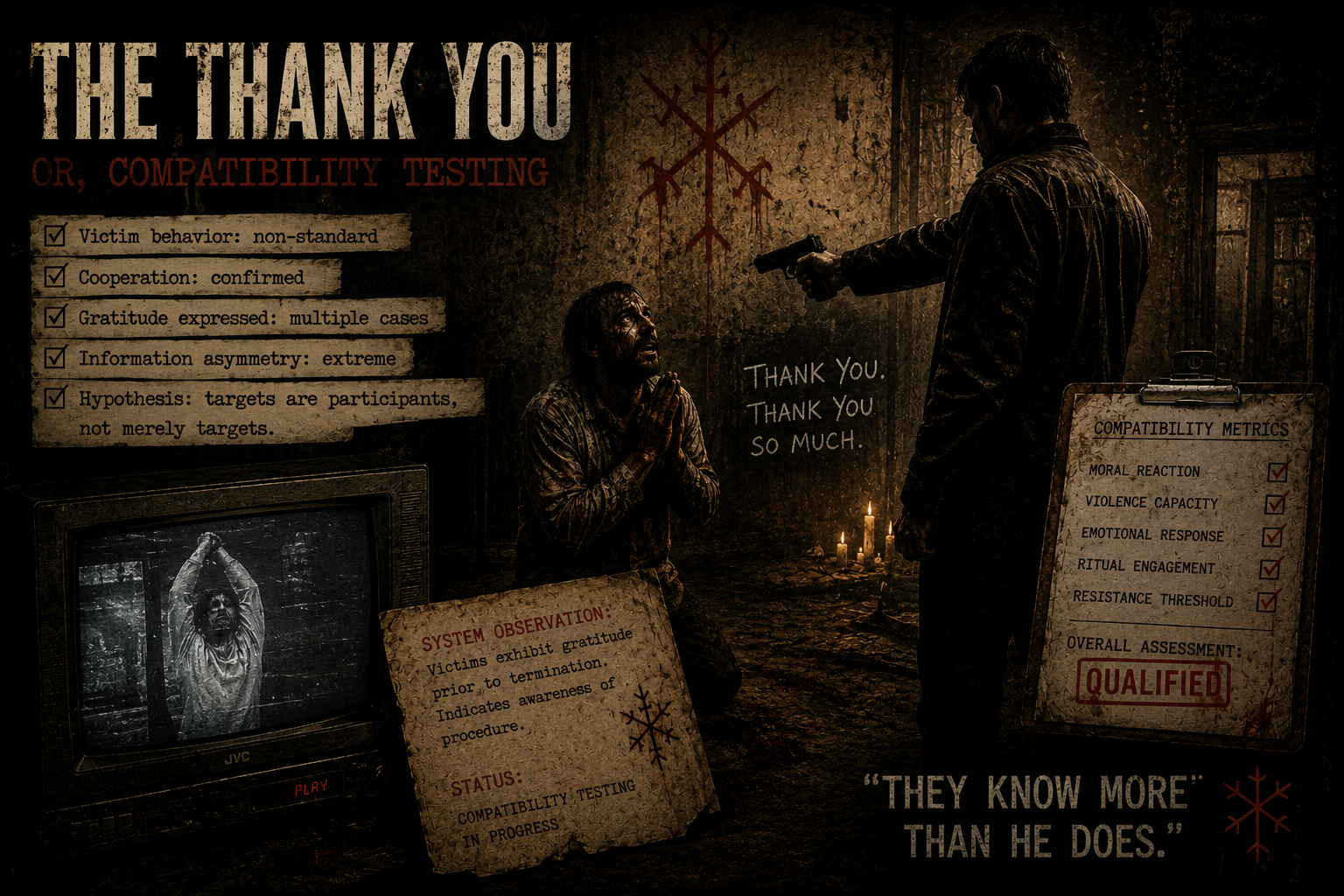
The victims do not behave like victims.
This is a problem.
The hitman explanation requires a specific workflow.
Target identified.
Target located.
Target eliminated.
Target objects to elimination.
This is standard operational procedure.
Kill List repeatedly refuses compliance.
Instead, several of Jay's targets respond in a manner that feels profoundly wrong.
They thank him.
Not after surviving.
Not after escaping.
Not after negotiating.
Before death.
The first occurrence can be dismissed.
The second becomes noticeable.
The third triggers a systems audit.
At this point, the Processor generated a formal inquiry:
WHY ARE THE VICTIMS COOPERATING WITH THE WORKFLOW?
No satisfactory response was provided.
This is where the film quietly begins changing genres.
The audience still believes it is watching a hitman movie.
The film appears to have moved on to something else.
The targets are not merely targets.
They are participants.
The killings are not merely killings.
They are procedures.
The contracts are not merely contracts.
They are stages.
The repeated expressions of gratitude become the film's most important clue.
Not because they explain the architecture.
Because they confirm the architecture exists.
Someone understands what is happening.
Someone recognizes the sequence.
Someone knows where this workflow ends.
Jay does not.
The audience does not.
Yet the victims do.
This creates one of the most unsettling sensations in the entire film.
The people being killed appear to possess more information than the man killing them.
The Processor refers to this condition as Information Asymmetry Infrastructure™.
A state in which one participant believes they understand the assignment while another participant quietly understands the entire organization.
Jay thinks he is completing contracts.
The victims behave as though Jay is completing a ritual.
The distinction changes everything.
By this stage of the film, the audience begins constructing a familiar narrative.
Jay discovers evil.
Jay becomes enraged.
Jay fights the system.
This appears to be the trajectory.
The Processor approved this trajectory.
It has worked reliably for decades.
A man sees something horrific.
A man grabs a weapon.
A man destroys the conspiracy.
Documentation complete.
Case closed.
The case was not closed.
Kill List continues supplying contradictory data.
The gratitude.
The symbols.
The strange witnesses.
The increasingly ceremonial nature of the violence.
Every new anomaly points toward a possibility the audience does not yet wish to consider.
Perhaps the system is not evaluating the victims.
Perhaps the system is evaluating Jay.
This possibility initially appears absurd.
After all, Jay is the protagonist.
Protagonists investigate systems.
Systems do not investigate protagonists.
The remainder of the film will challenge this assumption aggressively.
In retrospect, the evidence was already present.
The victims were never thanking their executioner.
They were acknowledging a participant.
The contracts were never evaluating targets.
The contracts were evaluating compatibility.
The hitman believed he was moving through the system.
The system was measuring whether he belonged inside it.
For Horror Processor purposes, this is the moment Kill List becomes genuinely dangerous.
The audience still believes Jay is uncovering the conspiracy.
The conspiracy may already be reviewing his qualifications.
SECTION III: THE CROWN
Or, Successful Processing
Every system produces an output.
This is one of the foundational principles of Horror Processor analysis.
A slaughterhouse produces meat.
A hospitality layer produces service.
A research institution produces data.
A ritual architecture must also produce something.
For much of Kill List, the audience assumes the output is death.
This is a reasonable conclusion.
People are killed.
Bodies accumulate.
Violence escalates.
The system appears destructive.
The Processor initially accepted this explanation.
The Processor was incorrect.
Death is not the product.
Death is the procedure.
The distinction becomes visible only in the film's final movement.
By this point, Jay believes he understands the architecture.
He has discovered the films.
He has discovered the hidden participants.
He has discovered the ritual layer operating beneath the hitman layer.
More importantly, he has discovered that the conspiracy is real.
Not metaphorically real.
Not psychologically real.
Organizationally real.
The symbols are real.
The participants are real.
The ceremonies are real.
The hidden network is real.
The films have already established the existence of an elite processing floor involving unimaginable abuse and violence.
The ritual merely reveals the architecture built above it.
Most importantly, Jay believes he has identified the enemy.
This is the traditional structure.
The protagonist discovers the conspiracy.
The protagonist confronts the conspiracy.
The protagonist attempts to destroy the conspiracy.
The Processor approved this trajectory.
It has demonstrated strong performance metrics for several decades.
A man discovers evil.
A man grabs a weapon.
A man destroys evil.
Documentation complete.
Case closed.
The case was not closed.
Kill List appears interested in a different workflow.
Then the architecture reveals its final layer.
The audience experiences the ending as a twist.
The Processor experiences it as a workflow completion event.
Everything that appeared random suddenly acquires function.
The contracts.
The victims.
The gratitude.
The symbols.
The films.
The tunnel.
The pursuit.
The sequence was never testing the targets.
The sequence was testing Jay.
This realization transforms the entire film.
The audience assumes Jay is moving through the system.
The ending suggests something much more disturbing.
The system has been moving Jay.
Every stage appears designed to answer a single question:
Is the candidate compatible?
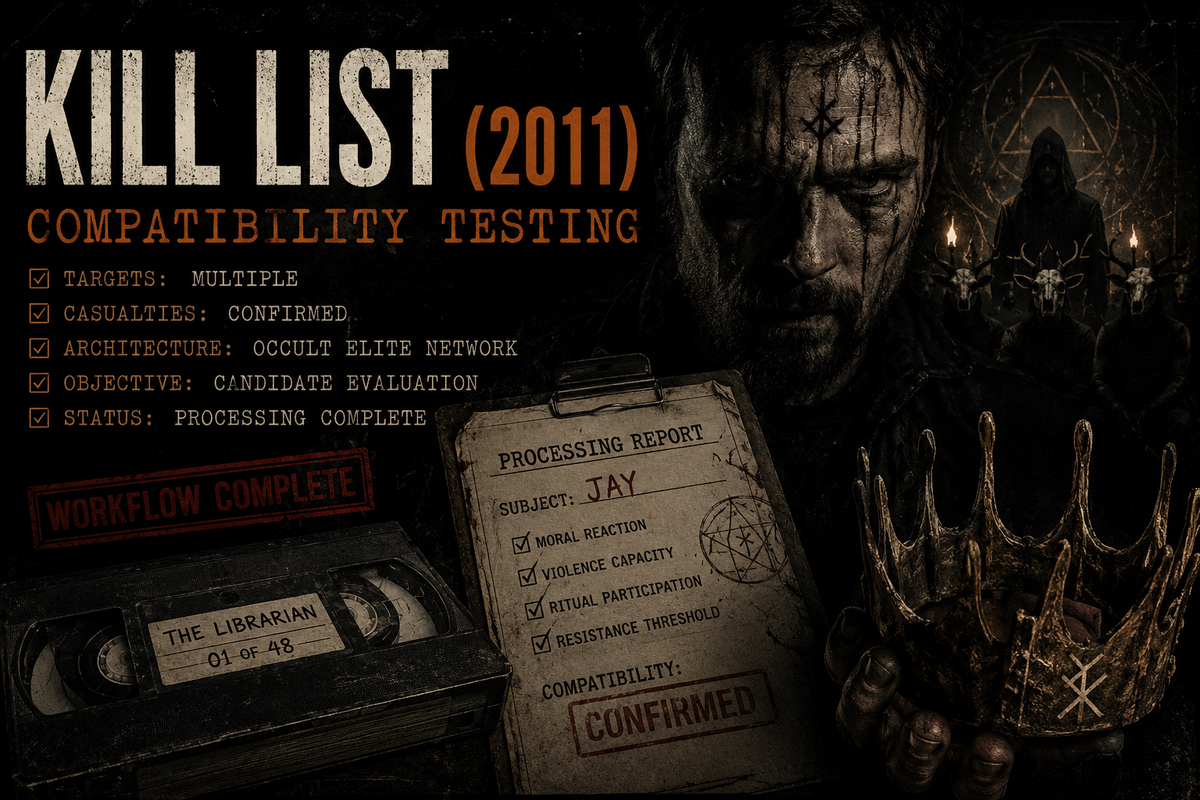
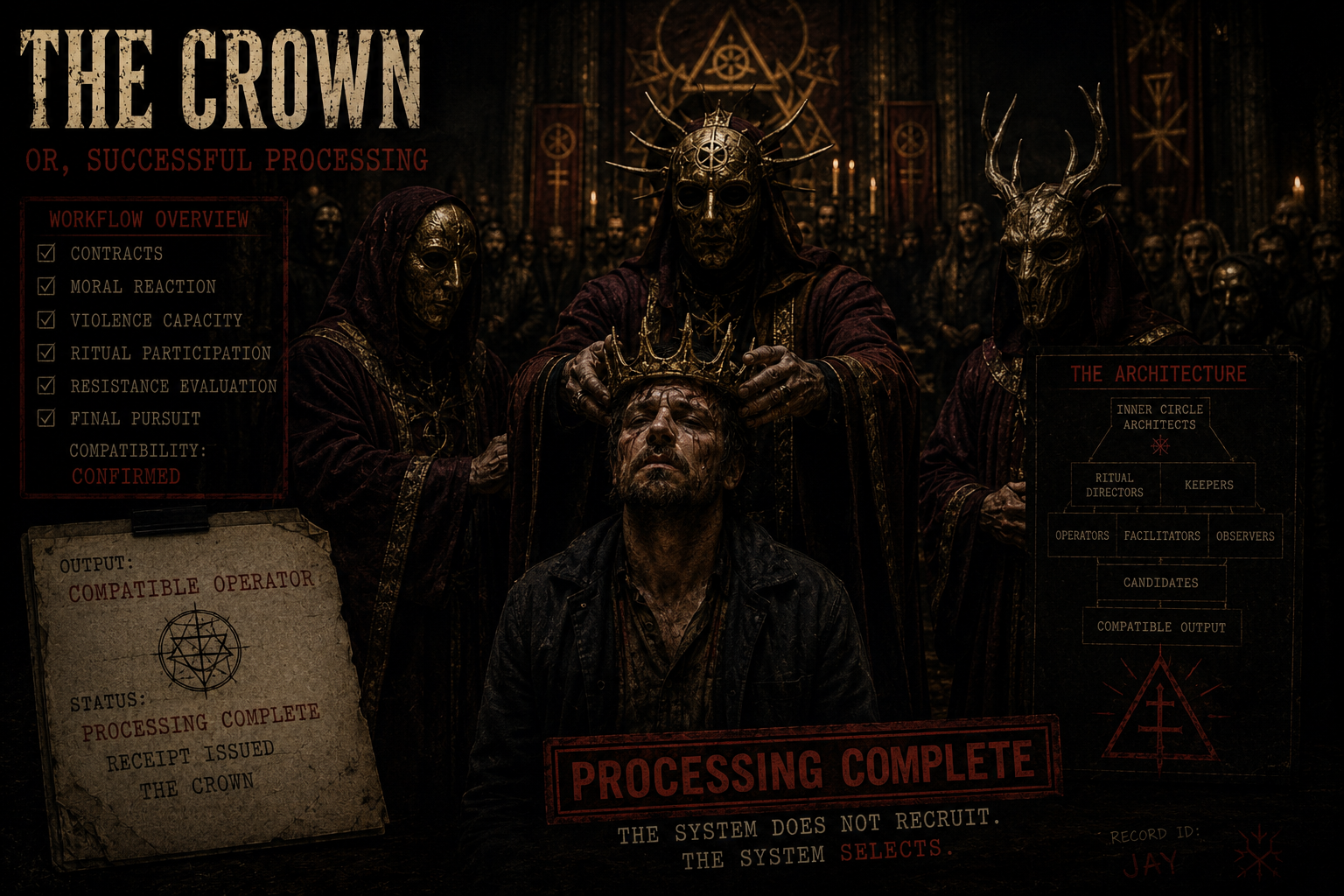
The films test moral reaction.
The violence tests capacity.
The ritual tests participation.
The architecture measures the results.
Then comes the crown.
This is the most important image in the film.
Not because it is shocking.
Because it is administrative.
The crown is not a reward.
The crown is a receipt.
It is the formal confirmation that processing has concluded successfully.
The cult does not gather to witness tragedy.
The cult gathers to witness completion.
This is what separates Kill List from more conventional conspiracy narratives.
In a film such as True Detective, the protagonists discover the processing floor and remain external to it.
They become witnesses.
Investigators.
Opponents.
In Kill List, Jay discovers the processing floor and becomes part of its output.
The system does not merely survive his rebellion.
The system incorporates his rebellion.
His rage was anticipated.
His violence was anticipated.
His resistance was anticipated.
Every attempt to fight the architecture ultimately becomes another stage within it.
This is why the ending lingers.
Not because the audience has unanswered questions.
Because the audience receives an answer it does not like.
The system was never recruiting.
The system was selecting.
The final horror of Kill List is not that an elite occult network exists.
The films already established that.
The final horror is that the network appears to have identified its candidate long before the audience arrived.
In most conspiracy horror, the protagonist discovers the hidden system.
In Kill List, the hidden system discovers the protagonist.
The hitman believed he was hunting the architecture.
The architecture was manufacturing the hitman.