A NIGHTMARE ON ELM STREET: WHEN SLEEP BECOMES HOSTILE TERRITORY
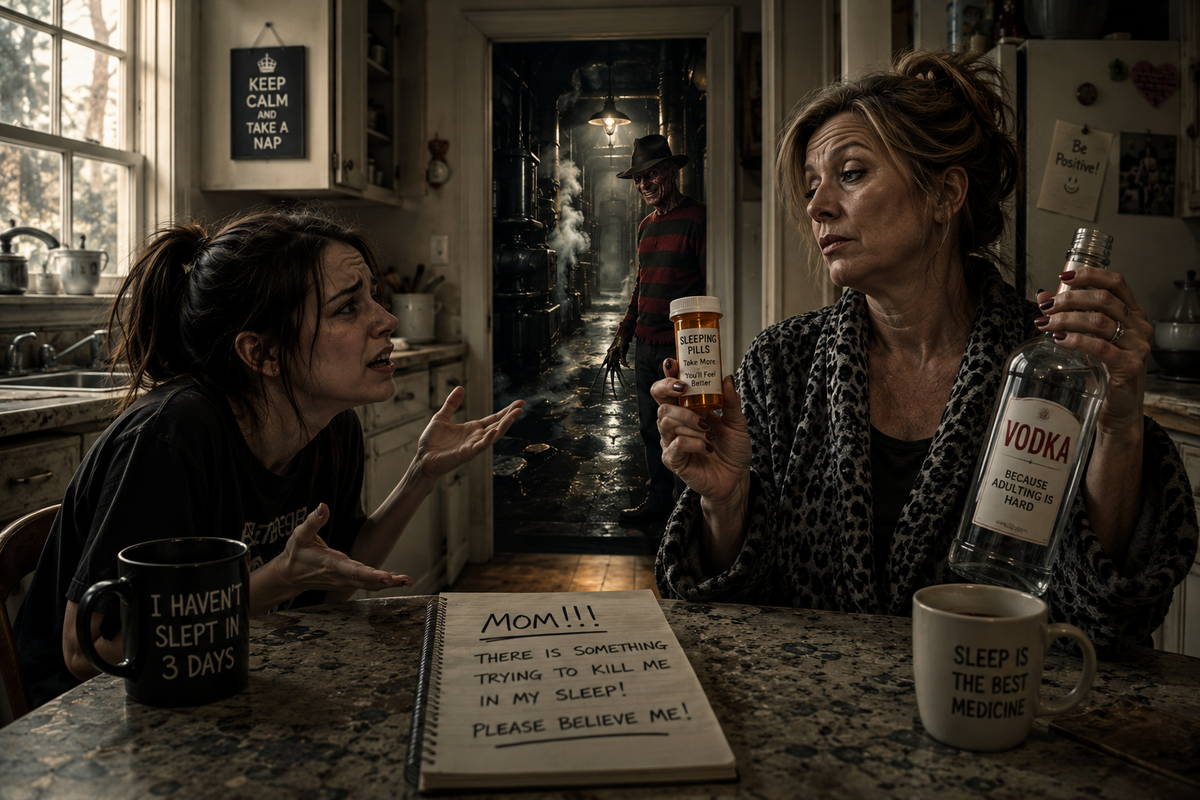
“Mom, there’s an entity trying to murder me in my sleep.”
“I see.”
“You understand what I’m saying?”
“Yes, dear.”
“Good.”
“You need sleeping pills.”
“No, Mom, you don’t understand. Sleep is where he murders people.”
“Yes, that does sound stressful.”
“Right, so perhaps the solution is… less sleep?”
“No.”
“No?”
“More sleep.”
“Mother, respectfully, that feels like the one variable we should be reducing.”
“Try to relax, dear.”
“Umm, he specifically attacks relaxed people.”
A Nightmare on Elm Street may contain the most unintentionally hilarious parental logic in horror history.
But that absurdity points directly to what makes the film genuinely frightening.
Because unlike many horror films, Elm Street is not simply about a killer.
It is about the collapse of the last territory human beings assume remains private.
The mind.
With The Texas Chain Saw Massacre, horror invades physical space.
With The Exorcist, metaphysical horror breaches domestic reality.
But A Nightmare on Elm Street goes somewhere even more intimate.
It invades consciousness itself.
And worse: entry is mandatory.
Eventually, your body makes the decision for you.
You will sleep.
Which already makes Freddy terrifying in a uniquely elegant way.
You can run from Leatherface.
You can avoid creepy houses.
You can, at least theoretically, seek priestly intervention for possession.
But Freddy?
Freddy attacks the one place you cannot permanently defend.
And then the film introduces something even more psychologically disturbing:
paranoia.
Because paranoia in fiction is powerful precisely because it weaponizes normal human threat detection.
The sequence is primal:
I detect danger.
Authority tells me I am mistaken.
Authority knows more than it admits.
Therefore authority may be complicit.
That is terrifying.
And Elm Street understands this perfectly.
Because Nancy’s horror is not simply that adults dismiss her.
That would be ordinary frustration.
The real horror is realizing the adults already know something.
The parents are not merely skeptical.
They are concealing historical violence.
They know Freddy existed.
They know what they did.
Which transforms the emotional architecture of the film.
Nancy is not trapped in a world where adults fail to understand the threat.
She is trapped in a world where the adults helped create it.
That changes everything.
Because once paranoia becomes justified—
once “They’re all in on it” stops sounding irrational—
the horror gets much darker.
At that point, A Nightmare on Elm Street stops being a slasher film.
It becomes systems horror.
A film about hostile dream architecture.
Institutional complicity.
And the horrifying realization that even sleep is no longer safe.
SECTION I — FREDDY DOESN’T KILL. HE PERFORMS.
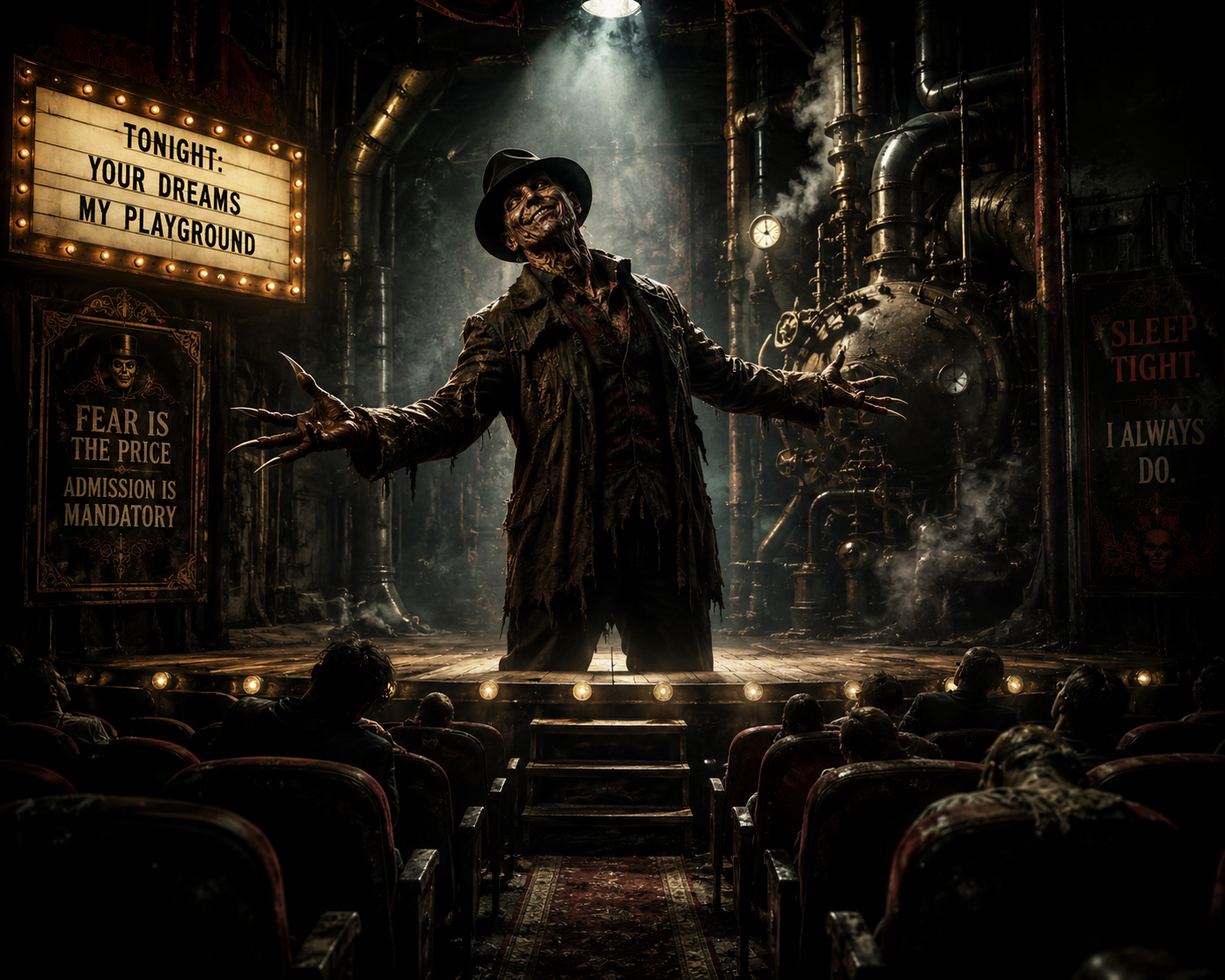
One of the things that makes Freddy Krueger uniquely disturbing is that he does not behave like a conventional slasher.
Michael Myers kills like a force of nature.
Minimal affect.
No flourish.
No theatricality.
He arrives. He executes. He leaves.
Leatherface, by contrast, often feels less like evil incarnate and more like a deeply distressed employee trying to finish an impossibly chaotic shift and eventually sit on the couch with a six-pack.
Freddy?
Freddy is having a wonderful time.
That distinction matters.
Because Freddy is not merely violent.
He is performative.
He enjoys anticipation.
Delay.
Mockery.
Psychological staging.
He doesn’t simply want to kill his victims.
He wants them afraid first.
Aware.
Participating.
Unlike many horror villains, Freddy does not function as blunt force trauma.
He functions as sadistic theatre.
Every dream becomes a personalized stage.
Every encounter becomes a performance.
And Freddy is always the star.
The lights go out?
Showtime.
That makes him psychologically much nastier than many of his slasher contemporaries.
Because he doesn’t just want your body.
He wants your fear.
Your attention.
Your helpless engagement.
And here’s what makes that even darker:
Freddy was already monstrous before the supernatural upgrade.
Unlike slashers whose mythology drifts into abstraction, Freddy begins as something horribly concrete.
A child murderer.
A predator.
The dream powers do not create evil.
They amplify pre-existing evil.
Which makes the parents’ vigilante justice one of the bleakest ideas in the film.
They discover the monster.
They burn him alive.
Adult response:
Justice.
Problem solved.
Except no.
Freddy's response:
"That's adorable. Now I'm trans-dimensional."
That is brutally dark.
Because the adults believe they eliminated the threat.
Instead, they upgraded it.
Their violence does not restore order.
It expands the operational territory of evil.
And that leads to one of the nastiest truths in Elm Street:
There is no justice here.
Only escalation.
Freddy does not lose.
He evolves.
SECTION II — YOU NEED A HALL PASS TO ESCAPE YOUR NIGHTMARE
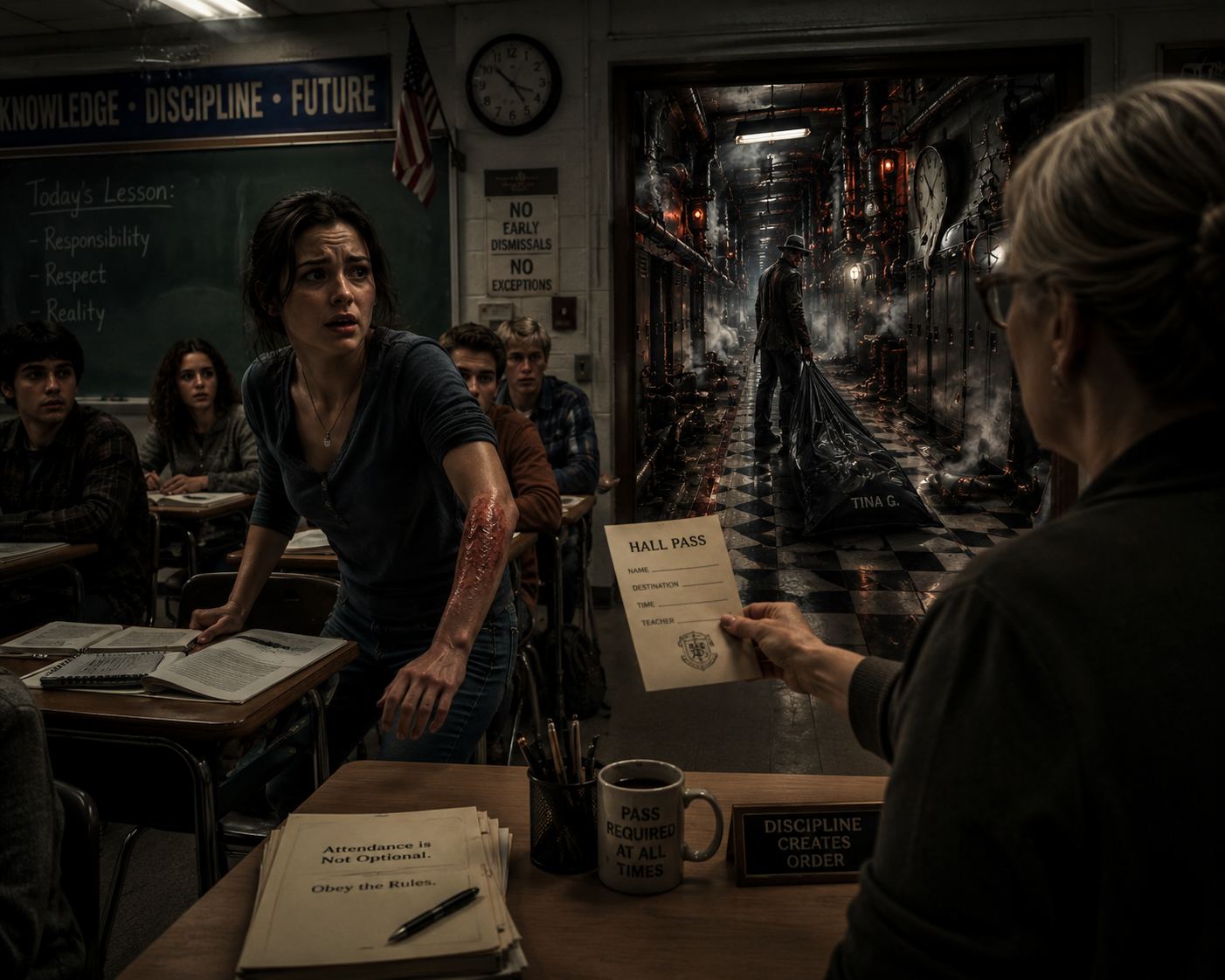
One of the most brilliant scenes in A Nightmare on Elm Street happens in the classroom.
Because this is where the film quietly destroys one of our foundational assumptions:
school should be safe.
Nancy is exhausted.
Traumatized.
Barely functioning.
Which is already relatable.
Then she drifts into microsleep.
And suddenly the school changes.
Tina appears.
Dead.
Body bagged.
Being dragged down the hallway.
And Freddy, in one of his earliest moments of gleeful theatricality, taunts:
“Don’t run in the halls.”
Which is objectively hilarious.
Because Freddy understands performance.
He doesn’t just threaten.
He stages.
Even his threats come with institutional irony.
But the deeper horror here is not Freddy’s sarcasm.
It is boundary collapse.
School is supposed to be structured reality.
Order.
Supervision.
Rules.
Safety.
Instead, the institution becomes porous.
Dream logic infiltrates educational space.
Private nightmare contaminates public reality.
That is psychologically destabilizing.
And then comes the crucial moment:
Nancy burns her arm.
She wakes.
The burn remains.
That changes everything.
Because now the film introduces one of its core rules:
dream-space is not symbolic.
It has material consequences.
This is not “just a dream.”
The body carries evidence.
Reality has been breached.
And then, in one of the funniest examples of institutional blindness in horror:
Nancy gets up to leave.
Because, quite reasonably, she is trying not to die.
And the teacher says:
“You need a hall pass.”
Perfect.
Because this is exactly how systems behave under anomalous pressure.
Reality may be collapsing.
A trans-dimensional child murderer may be invading consciousness.
And bureaucracy responds:
Please complete the appropriate paperwork.
That’s not just funny.
That’s Horror Processor gold.
Because institutional systems are built to process normal deviations.
Tardiness.
Absence.
Discipline.
What they cannot process is ontological threat.
So the machine keeps running.
Even when reality no longer conforms to the model.
And that is the real horror.
Nancy is detecting genuine danger.
The institution reads behavioral noncompliance.
Classic misclassification.
SECTION III — THERE ARE NO SAFE SPACES
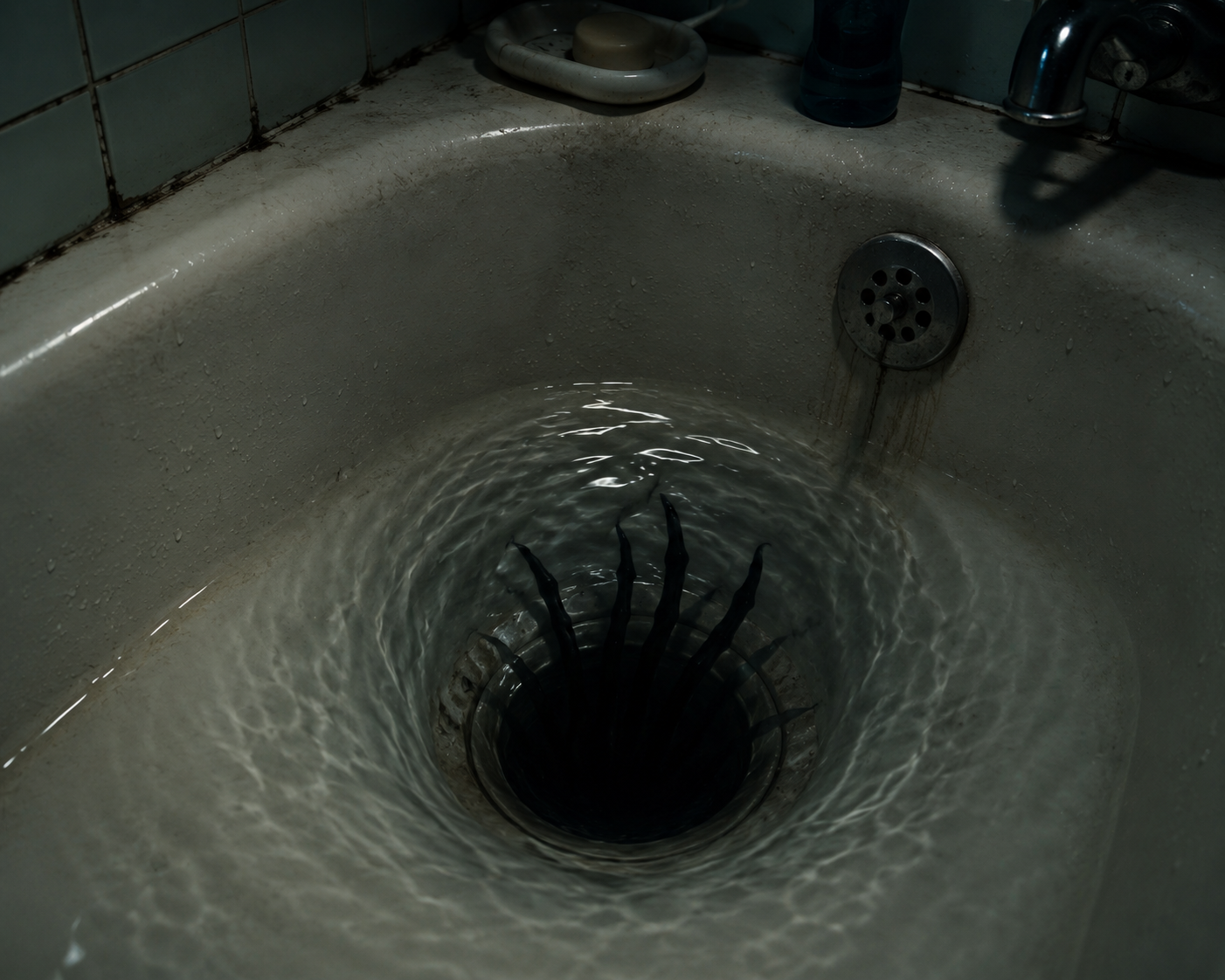
Few horror images are as instantly recognizable as the bathtub scene in A Nightmare on Elm Street.
Nancy, exhausted beyond function, slides into a bath.
And because this is the 1980s, the camera gently reminds us that apparently no scene involving water could exist without at least the faint innuendo of unnecessary sexual subtext.
Cinema was going through something.
But once we move past that deeply period-specific creative decision, the scene becomes genuinely brilliant.
Because what Elm Street understands is that horror escalates by systematically collapsing categories of safety.
The classroom scene told us institutions cannot protect you.
The bathtub scene tells us private sanctuary cannot protect you either.
A bath is culturally coded as safety.
Privacy.
Domestic retreat.
Vulnerability without threat.
A temporary withdrawal from the world.
Nancy is not making a tactical error.
She is doing something fundamentally human.
Trying to rest.
Trying to recover.
Trying to reclaim control over a body that is failing.
And that is exactly why Freddy chooses this moment.
Because Freddy does not merely attack bodies.
He attacks assumptions.
And one of the most primal assumptions human beings carry is this:
when I am alone, in my own private space, I am safe.
Then the glove rises from between her legs.
Which, yes, is about as subtle as 1980s horror gets.
But psychologically, the image works because of where the threat emerges.
Not from a window.
Not from the bathroom door.
Not from outside.
From inside the intimate environment itself.
That distinction matters.
Because this is no longer invasion horror.
This is environmental contamination.
The safe space itself becomes hostile.
That is terrifying.
And Horror Processor-wise, this scene tells us something crucial:
Freddy does not simply inhabit dream space.
He exploits liminal states.
Threshold conditions.
Nancy is neither fully awake nor fully asleep.
Floating.
Relaxed.
Boundary-softened.
Exactly where consensus reality becomes unstable.
This is Freddy’s ideal operational environment.
And, as always, Freddy performs.
He does not immediately kill.
He intrudes.
Suggests presence.
Lets dread breathe.
Because Freddy is not merely a killer.
He is a sadist.
He enjoys anticipation.
That’s what makes him uniquely nasty.
Michael Myers kills.
Leatherface panics through murder like a deeply stressed employee nearing the end of a catastrophic shift.
Freddy?
Freddy enjoys the show.
And the bathtub scene makes something horrifyingly clear:
school is unsafe.
Home is unsafe.
Privacy is unsafe.
Even your own exhausted body is unsafe.
At this point in the film, Nancy no longer lacks protection.
She lacks territory.
FINAL SECTION — FREDDY LET HER THINK SHE UNDERSTOOD THE RULES
One of the reasons A Nightmare on Elm Street remains so effective is that Nancy is not a passive victim.
She learns.
Adapts.
Studies the architecture.
Unlike everyone around her, Nancy takes the threat seriously.
She behaves less like a horror victim and more like a systems analyst.
If Freddy attacks through dream logic, then perhaps the answer is operational understanding.
Learn the rules.
Control the variables.
Fight back.
And to the film’s credit, it appears—for a while—that this works.
Meanwhile, poor Glen, perhaps the most aesthetically gifted sleeper in American cinema, gets sucked into his bed and converted into approximately forty gallons of arterial smoothie.
Which leads to one of the film’s funniest and darkest moments.
Because after a teenage boy is effectively converted into a human blood geyser by forces no rational framework could possibly explain, the adult response is essentially:
“We don’t need an ambulance. We need a mop.”
Perfect.
Because this is Elm Street in miniature.
Reality presents overwhelming evidence of ontological catastrophe.
Adults remain trapped in interpretive paralysis.
No true reclassification occurs.
The anomaly keeps happening.
The paperwork continues.
Nancy’s mother, operating at her usual BAC, arrives at the brilliant strategic conclusion:
lock Nancy inside the house.
Because if your daughter is being pursued by a trans-dimensional dream predator, what she clearly needs is fewer exits.
Nancy, to her credit, comes prepared.
Booby traps.
Improvised defenses.
Operational planning.
For a brief stretch, Elm Street becomes Home Alone directed by Satan.
And if we’re being honest, part of the audience starts thinking:
…wait.
Is Freddy seriously getting Home Aloned right now?
Is this actually working?
But the ending suggests something much darker.
What if it was never working?
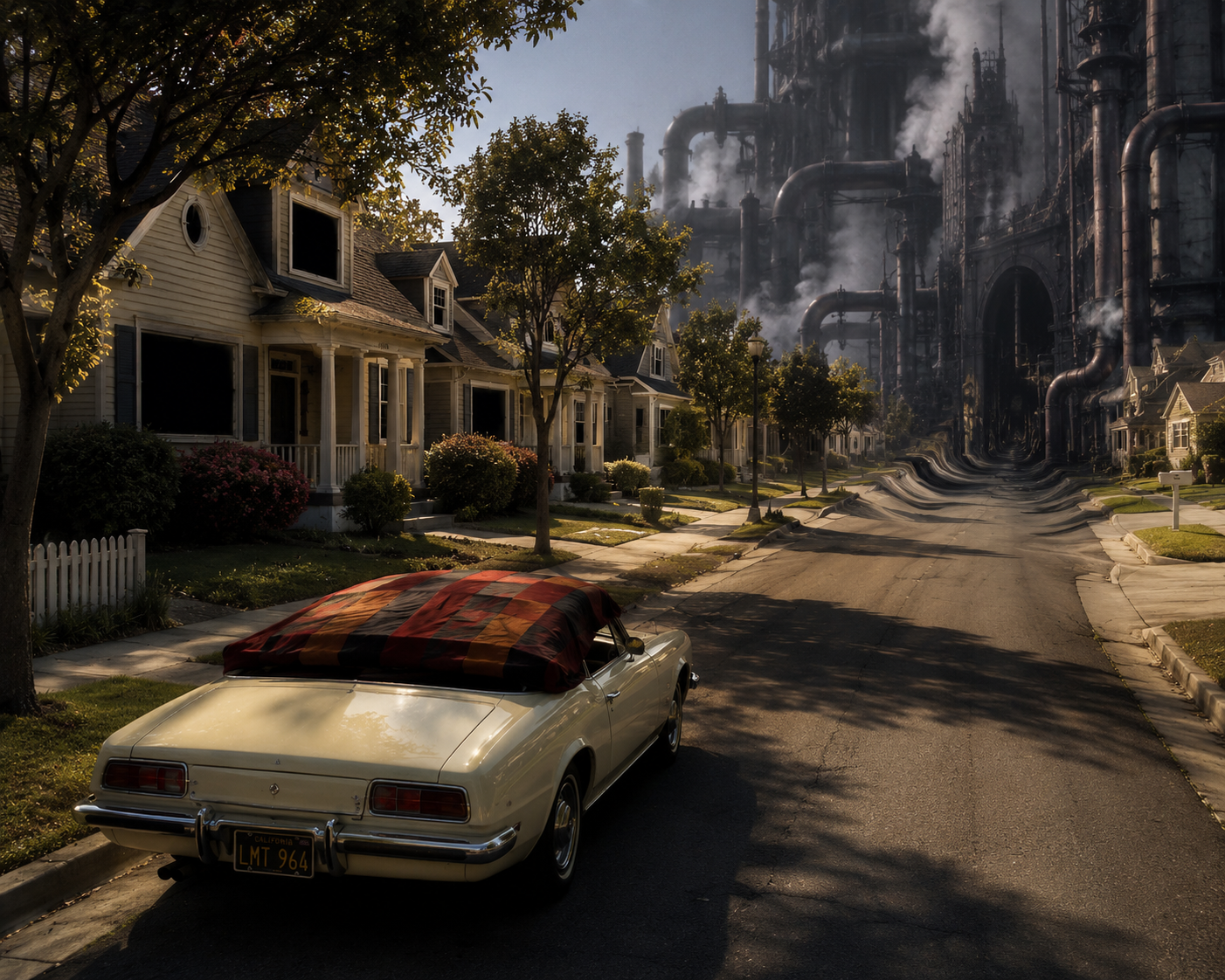
What if Freddy allowed Nancy to believe she had understood the system?
Allowed her to believe she had brought him into waking reality.
Allowed her to believe the rules had changed.
Because that would be perfectly consistent with everything we already know about Freddy.
He performs.
He stages.
He manipulates anticipation.
He enjoys false hope.
And if that reading holds, then the ending becomes terrifying.
Nancy never dragged Freddy into her world.
Freddy dragged Nancy deeper into his.
Which would mean the apparent shift into “real-world logic” was itself part of the dream architecture.
A controlled illusion.
A final act.
Because the last images matter.
Freddy wins.
Reality remains unstable.
Closure collapses.
And that brings us to the final Horror Processor thesis:
A Nightmare on Elm Street is not terrifying because a killer attacks teenagers in their dreams.
It is terrifying because it suggests consciousness itself is vulnerable infrastructure.
That sleep is forced compliance.
That paranoia may be justified.
That adults may already be complicit.
And worst of all—
that once you think you understand the architecture…
you may already be exactly where the architect wanted you.