WHAT YOU WISH FOR: THE HOSPITALITY LAYER
INTRODUCTION: A PROCESSING ERROR
Every system occasionally misclassifies incoming data.
The Horror Processor is no exception.
Several evenings ago, the Processor attempted to locate a film involving luxury hospitality, isolated wealth, hidden infrastructure, and elite consumption systems. What followed was an unexpected classification error.
The target was What You Wish For.
The Processor instead selected The Menu.
At first glance, the confusion appeared understandable. Both films concern food, wealth, exclusivity, and the uncomfortable possibility that the upper tiers of society may operate according to rules inaccessible to ordinary participants.
Yet as processing continued, anomalies emerged.
The Processor began searching for procurement systems.
It searched for logistics.
It searched for hidden infrastructure.
It searched for administrative continuity.
Most importantly, it searched for the processing floor.
The processing floor never arrived.
Instead, The Menu revealed itself to be something else entirely: a highly entertaining Yelp review with arson.
This is not a criticism.
It is merely a correction.
The Processor had not encountered the wrong film.
It had applied the wrong classification model.
The distinction is significant.
The Menu asks:
What does elite consumption mean?
What You Wish For asks a far more dangerous question:
How does elite consumption function?
For Horror Processor purposes, this is a much more interesting inquiry.
Because systems horror rarely begins with violence.
It begins with architecture.
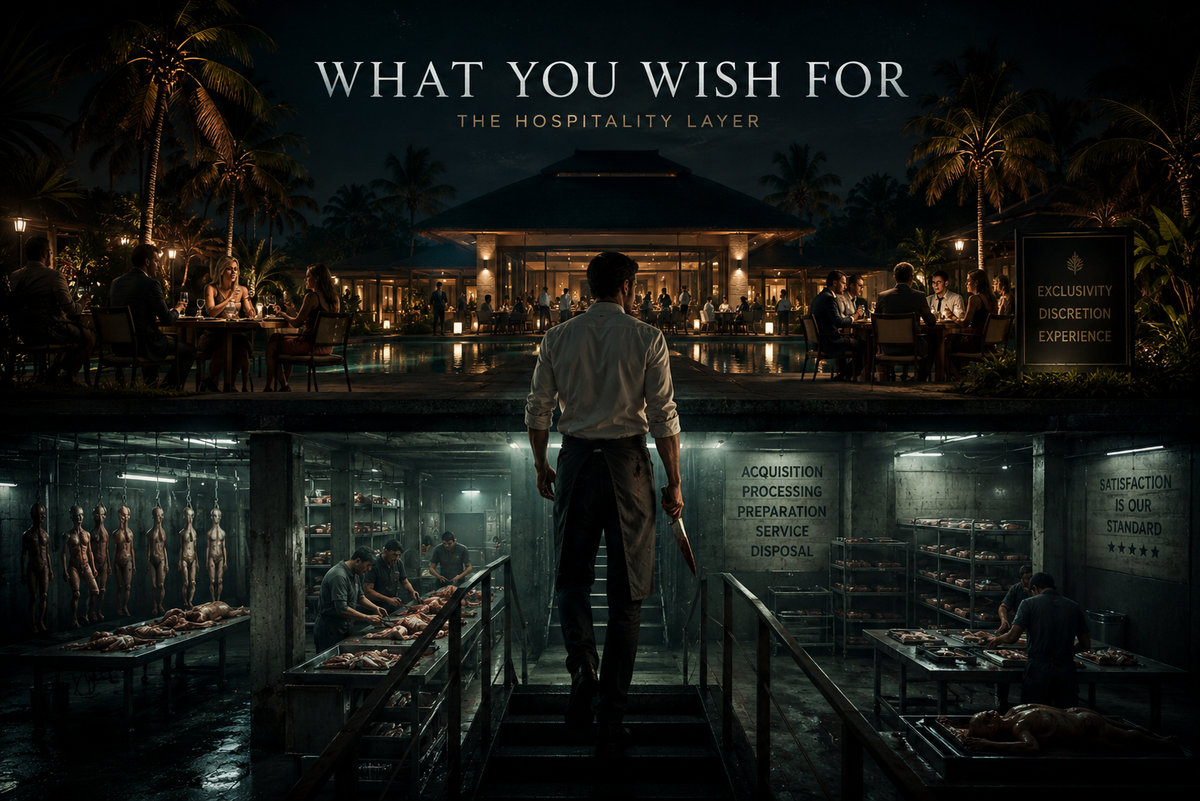
The opening of What You Wish For immediately establishes the correct conditions. A remote tropical location. An isolated luxury estate. Wealth operating beyond ordinary visibility. Professional staff moving through spaces they understand better than the audience.
Nothing supernatural is present.
Nothing impossible is occurring.
The environment is disturbing precisely because it appears plausible.
The estate does not suggest evil.
It suggests access.
And access has always been one of the primary indicators of hidden architecture.
The opening understands a principle many contemporary horror films have forgotten:
Reality is frightening long before monsters arrive.
A secluded compound. International wealth. Hospitality protocols. Geographic isolation. The quiet implication that certain people may enter these spaces while others never will.
Every element feels legitimate.
Which produces the central question hanging over the film's opening movements:
What exactly is being serviced here?
For Horror Processor analysis, this is always the correct question.
The most terrifying basement is not the one containing monsters.
It is the one containing workflow.
The monster can be removed.
The workflow remains.
There is, however, another reason the film succeeds.
Most horror films begin with a protagonist discovering that reality is worse than they imagined.
What You Wish For begins with a protagonist who adapts to reality faster than the audience expects.
Ryan may be one of the most unusual horror protagonists in recent memory.
He is not a detective.
He is not an action hero.
He is not a revolutionary.
He is not even particularly interested in uncovering the system.
Instead, Ryan performs a function rarely seen in modern horror:
He updates.
New information arrives.
Ryan adjusts.
A friend dies.
Ryan adjusts.
An identity becomes available.
Ryan adjusts.
The architecture reveals another layer.
Ryan adjusts.
The audience keeps waiting for panic.
Ryan keeps installing updates.
Throughout the film, horrifying information arrives faster than emotional processing can occur. The result is not denial. It is not courage. It is not heroism.
The result is adaptation.
For Horror Processor purposes, this phenomenon will be referred to as:
BRO PROCESSOR™.
A specialized cognitive framework in which emotional collapse is continuously postponed until operational requirements have been satisfied.
Friend dead?
Update.
Identity theft?
Update.
Human procurement network?
Update.
Body processing floor?
Update.
No one leaves?
Update.
Bro will panic later.
The system currently requires a response.
This turns out to be one of the film's most brilliant ideas.
Most horror protagonists spend their time resisting reality.
Ryan spends the film accepting reality and attempting to determine what must be done next.
The result is both hilarious and unexpectedly believable.
By the time the film reveals its deeper architecture, Ryan is not investigating a conspiracy.
He is onboarding into a workflow.
And that distinction changes everything.
SECTION II: THE BRO PROTOCOL
Or, How Ryan Became Workflow Compatible
Most horror protagonists operate according to emotional logic.
They discover something horrifying.
They deny it.
They fear it.
They resist it.
They investigate it.
They attempt to destroy it.
Ryan operates according to a completely different framework.
Ryan operates according to procedural logic.
When new information arrives, he does not deny it.
He incorporates it.
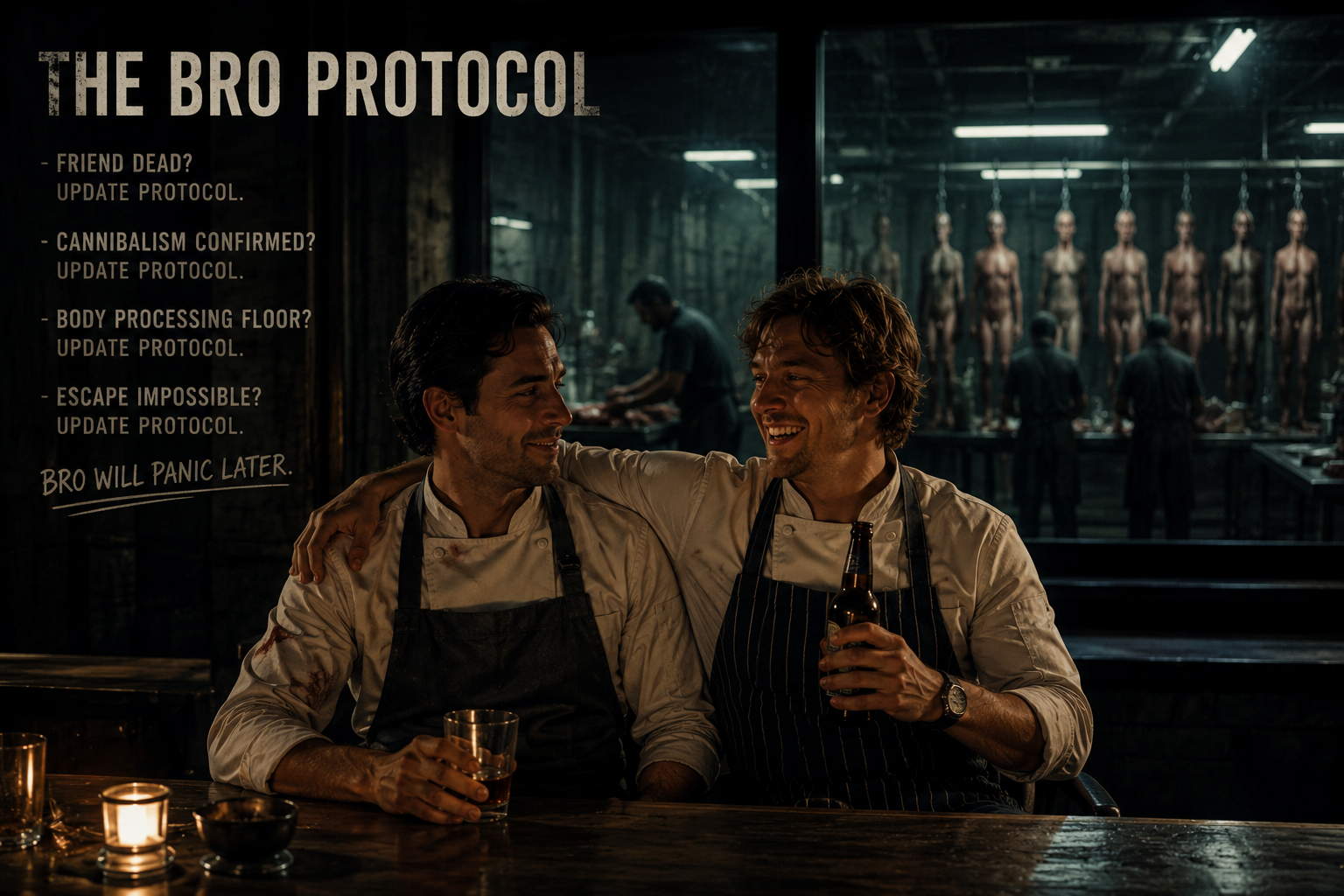
Friend dead?
Update protocol.
Identity available?
Update protocol.
Cannibalism confirmed?
Update protocol.
Body processing floor?
Update protocol.
Escape impossible?
Update protocol.
The result is one of the most unusual horror protagonists in recent memory: a man who appears to be processing reality as quickly as the film can generate it.
This sounds like a joke.
It is not.
In fact, it may be the film's greatest strength.
The genius of Ryan is that he never behaves like a horror protagonist.
He behaves like a professional.
A chef.
A working man.
A person accustomed to solving immediate problems while postponing existential crises until after the shift ends.
Most films would transform Ryan into a detective.
What is happening?
Who is responsible?
How deep does this conspiracy go?
Ryan asks a different question:
What do I need to do next?
This distinction becomes increasingly important as the film progresses.
When Ryan discovers Jack's body, the film refuses spectacle. There is no dramatic musical cue. No screaming. No theatrical breakdown.
Instead, Ryan does what many people would actually do.
He processes.
He walks away.
He thinks.
He looks again.
He confirms.
The moment works because the film understands something many thrillers forget:
Catastrophe is often confusing before it becomes frightening.
The brain attempts to classify what it is seeing before it can react to it.
Ryan's response feels authentic because it is rooted in cognition rather than performance.
This pattern repeats throughout the entire film.
When Ryan assumes Jack's identity, the screenplay makes another unexpected choice.
There is no prolonged internal debate.
No twenty-minute moral crisis.
No elaborate discussion of whether he can pull it off.
The situation presents a problem.
Ryan implements a solution.
The audience expects hesitation.
Ryan updates the protocol.
The same thing happens when the architecture begins revealing itself.
A lesser film would repeatedly stop the narrative so Ryan could announce how horrifying everything is.
What You Wish For understands that Ryan already knows things are horrifying.
The problem is that horrifying information continues arriving faster than he can emotionally process it.
By the middle of the film, Ryan resembles a man receiving catastrophic emails faster than he can clear his inbox.
Friend dead.
Identity stolen.
Cannibal infrastructure confirmed.
Body processing floor discovered.
Local authorities compromised.
No one leaves.
Each revelation would be enough to sustain an entire horror film.
Ryan receives all of them before lunch.
The result is what Horror Processor will officially classify as:
BRO PROCESSOR™.
A specialized cognitive framework in which emotional collapse is continuously postponed until operational requirements have been satisfied.
Bro will panic later.
The system currently requires a response.
What makes this funny is that it is true.
What makes it frightening is that it is also believable.
Ryan is not fearless.
He is overloaded.
The horror keeps arriving faster than emotional integration can occur.
So Ryan defaults to what he understands best:
The next task.
The next problem.
The next decision.
The next protocol update.
This is why the film's humor and horror become strangely intertwined.
The audience laughs because Ryan's adaptability becomes absurd.
The audience remains invested because that adaptability feels real.
Most people imagine they would immediately confront the horror.
Many people would probably do exactly what Ryan does.
Accept the new information.
Deal with the immediate problem.
Promise themselves they will process the implications later.
Then receive another update before later arrives.
By the end of the film, Ryan has become something very unusual.
Not a hero.
Not a detective.
Not a revolutionary.
A man who survived because he adapted faster than the architecture expected him to.
In Horror Processor terminology:
Ryan did not defeat the workflow.
Ryan became workflow compatible.
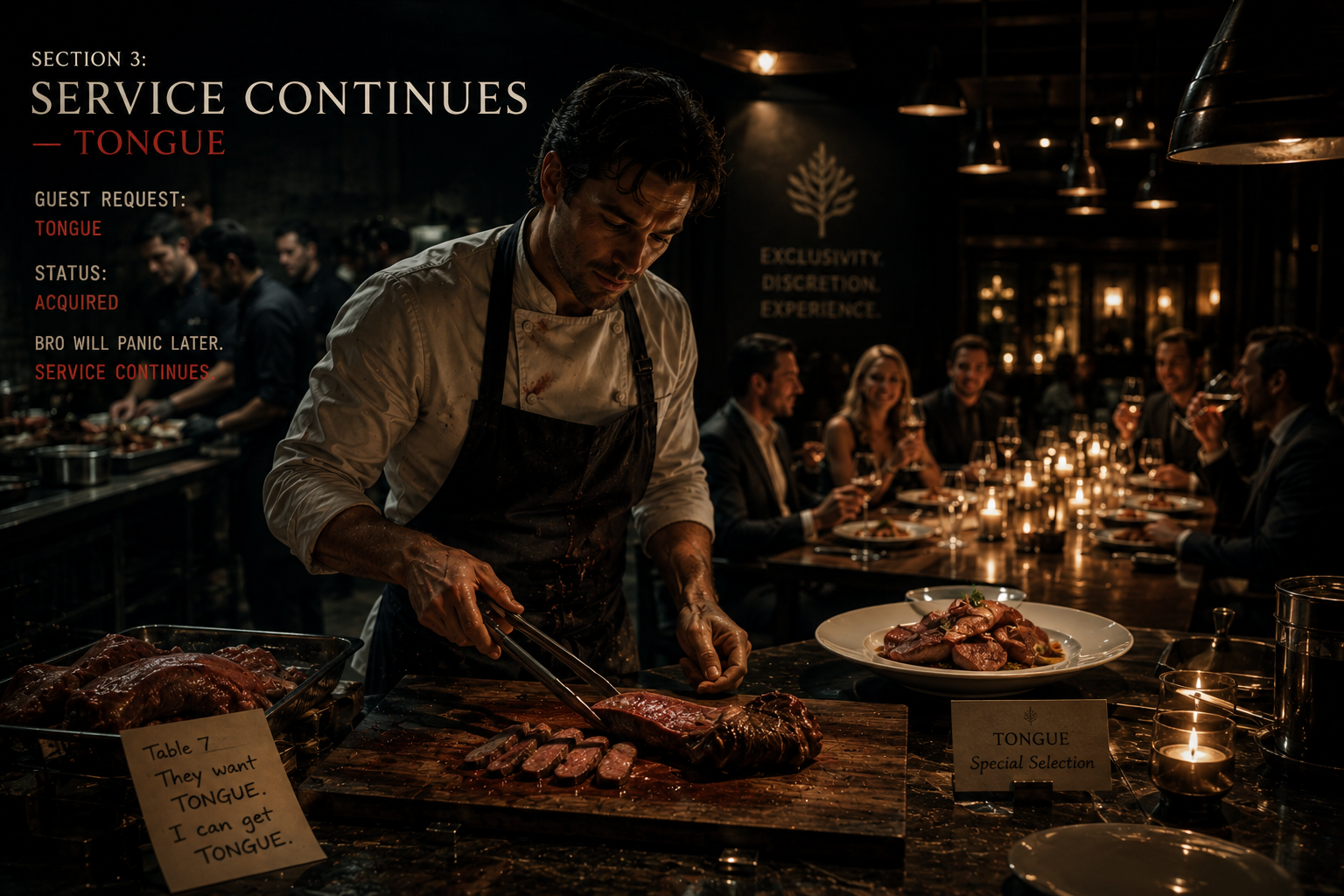
SECTION III: SERVICE CONTINUES
Or, Why the Tongue Scene Is the Most Important Scene in the Film
Most horror films pause when the horror is revealed.
What You Wish For does something much stranger.
It continues service.
This may be the film's most brilliant decision.
By the midpoint of the story, Ryan has already received enough horrifying information to sustain an entire horror movie.
His friend is dead.
He has assumed another man's identity.
He has discovered an international network built around human consumption.
He has witnessed murder.
He has discovered the processing floor beneath the luxury architecture.
Most films would stop here.
The protagonist would panic.
The protagonist would investigate.
The protagonist would announce to the audience that everything is terrible.
Instead, dinner service continues.
And so does Ryan.
This is where the film's understanding of professional competence becomes crucial.
Ryan is a chef.
Chefs operate within workflows.
Tickets arrive.
Orders arrive.
Problems arrive.
Service continues.
The architecture does not pause simply because someone has become morally uncomfortable.
Which leads to one of the film's funniest and most revealing moments.
The guests request tongue.
Not metaphorical tongue.
Not symbolic tongue.
Tongue.
The audience is still attempting to process the fact that wealthy elites are consuming human beings.
Ryan receives a new task.
The guests want tongue.
Ryan acquires tongue.
Bro will panic later.
The moment works because it feels absurd and believable at the same time.
A lesser film would use the scene to emphasize Ryan's horror.
What You Wish For uses the scene to emphasize Ryan's adaptation.
The architecture has already updated.
Ryan is struggling to keep pace.
The result is a protagonist who increasingly resembles a man receiving catastrophic emails faster than he can clear his inbox.
Human procurement network confirmed.
Body processing floor confirmed.
Tongue required.
Action required.
The queue continues.
The workflow continues.
Ryan continues.
Yet the scene's true purpose does not become clear until later.
The film eventually places Ryan and the detective together in one of its most effective sequences.
The detective has spent much of the story operating according to pattern recognition.
Something is wrong.
People are disappearing.
The official explanations do not fit the evidence.
Like the audience, he understands there is a mystery.
Unlike Ryan, he has not yet seen the architecture beneath it.
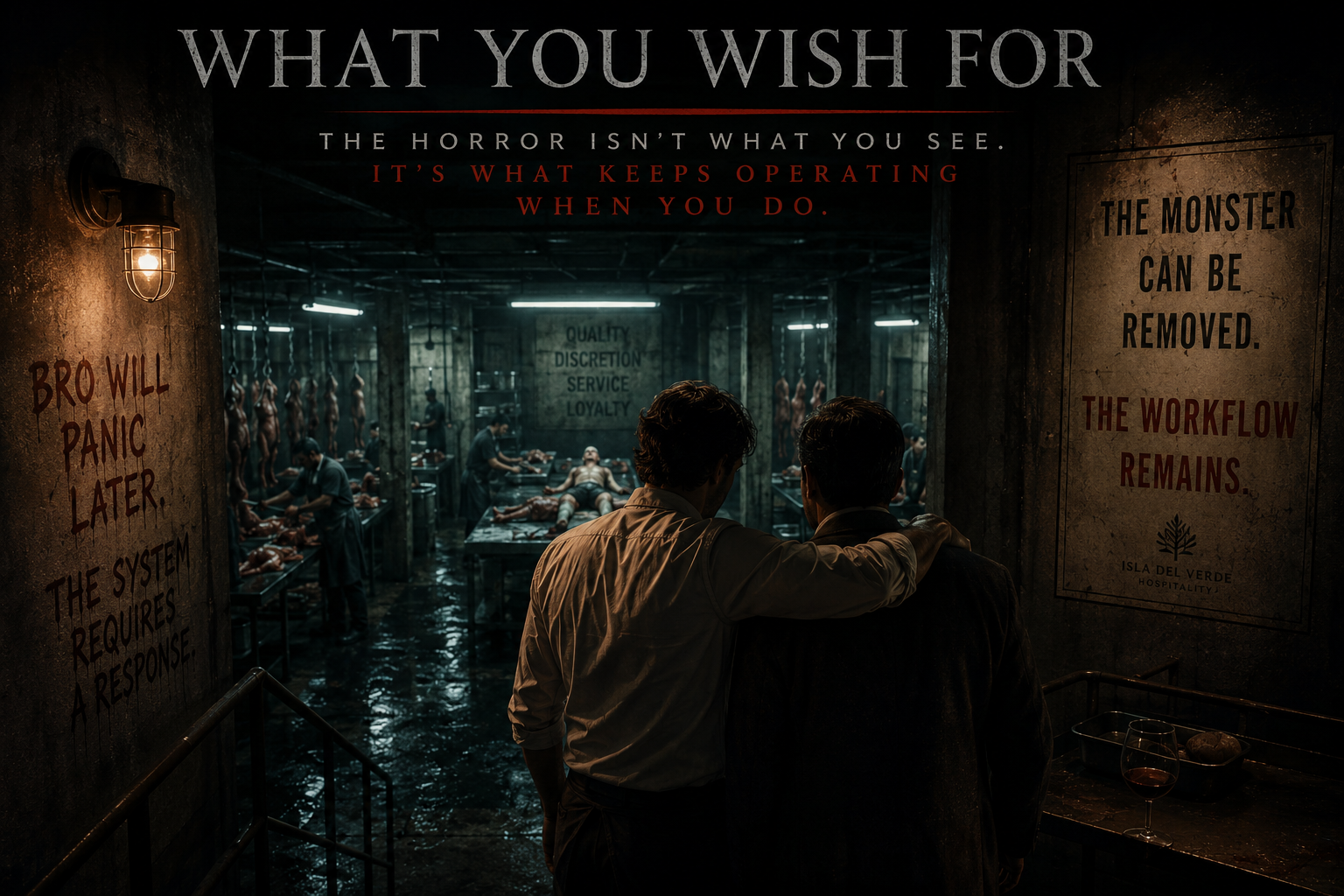
Ryan finally takes him below.
Into the underneath.
Into the processing layer.
Into the space where luxury becomes logistics.
The detective enters expecting answers.
Instead, he receives reality.
A body.
Evidence.
The hidden workflow made visible.
And then Ryan delivers one of the most horrifying lines in the entire film.
Not because it is dramatic.
Not because it is theatrical.
Because it is procedural.
That is why you couldn't identify the meat.
The mystery collapses instantly.
The architecture becomes visible.
The detective is no longer investigating a possibility.
He is standing inside a system.
The tongue scene now acquires a different meaning.
What seemed absurd moments earlier becomes evidence.
What seemed impossible becomes operational.
What seemed like a nightmare reveals itself to be procedure.
This is the moment the film fully transforms from thriller into infrastructure horror.
Not because people are being eaten.
But because the audience finally understands that there is a workflow for eating them.
The monster has been replaced by administration.
The mystery has been replaced by logistics.
The horror is no longer hidden.
It has become functional.
FINAL ASSESSMENT: THE HOSPITALITY LAYER
Or, Why This Film Works
The easiest version of What You Wish For is a cannibal movie.
The actual film is considerably more interesting.
Cannibalism is merely the visible surface.
The real subject is infrastructure.
From its opening moments, the film understands a principle that Horror Processor has repeatedly encountered throughout the genre:
The deepest horror is not the monster.
The deepest horror is the realization that a workflow exists.
Monsters are anomalies.
Workflows are systems.
Monsters are unpredictable.
Workflows are repeatable.
Monsters terrify because they appear suddenly.
Workflows terrify because they were already there.
What You Wish For understands this distinction completely.
Every layer of the film reinforces it.
The isolated estate.
The hospitality protocols.
The international clientele.
The procurement process.
The processing floor.
The administrative rationalizations.
The statistics.
The logistics.
Every revelation moves the audience further away from individual evil and closer to organized procedure.
The film never asks us to fear a monster.
It asks us to fear competence.
Maurice is frightening because he is effective.
The operations manager is frightening because she is reasonable.
The guests are frightening because they are comfortable.
Nobody behaves like a movie villain.
Everyone behaves like a participant.
This is what makes the architecture believable.
And because the architecture is believable, the horror becomes believable.
Yet the film's greatest achievement is Ryan.
Most modern horror protagonists are investigators.
They uncover the system.
Ryan does something far more interesting.
He survives inside the system.
His defining characteristic is not bravery.
It is adaptation.
Every revelation arrives faster than emotional processing can occur.
Ryan updates.
The audience waits for panic.
Ryan updates.
The audience waits for rebellion.
Ryan updates.
The audience waits for a speech.
Ryan updates.
This continues until the audience realizes something important:
Ryan is behaving exactly the way many people actually behave when confronted with overwhelming reality.
Not heroically.
Not perfectly.
Procedurally.
One task at a time.
One decision at a time.
One protocol update at a time.
The result is one of the most believable protagonists in recent horror.
By the film's conclusion, What You Wish For has quietly achieved something rare.
It has transformed a premise that could have become absurd into something disturbingly plausible.
The audience does not leave wondering whether such a system could exist.
The audience leaves wondering how many layers of reality operate according to principles they simply never see.
This is the hallmark of effective systems horror.
The film does not reveal a hidden monster.
It reveals a hidden layer.
A layer of logistics.
A layer of administration.
A layer of procedure.
A hospitality layer.
And once seen, it becomes difficult to stop looking for similar architectures elsewhere.
That is why the film succeeds.
That is why the film lingers.
And that is why What You Wish For earns a place in the Horror Processor canon.
Not because it horrifies.
Because it operationalizes horror.
The monster can be removed.
The workflow remains.