THE BRIDE (2025): REANIMATION FAILURE When Ideology Replaces Narrative Architecture
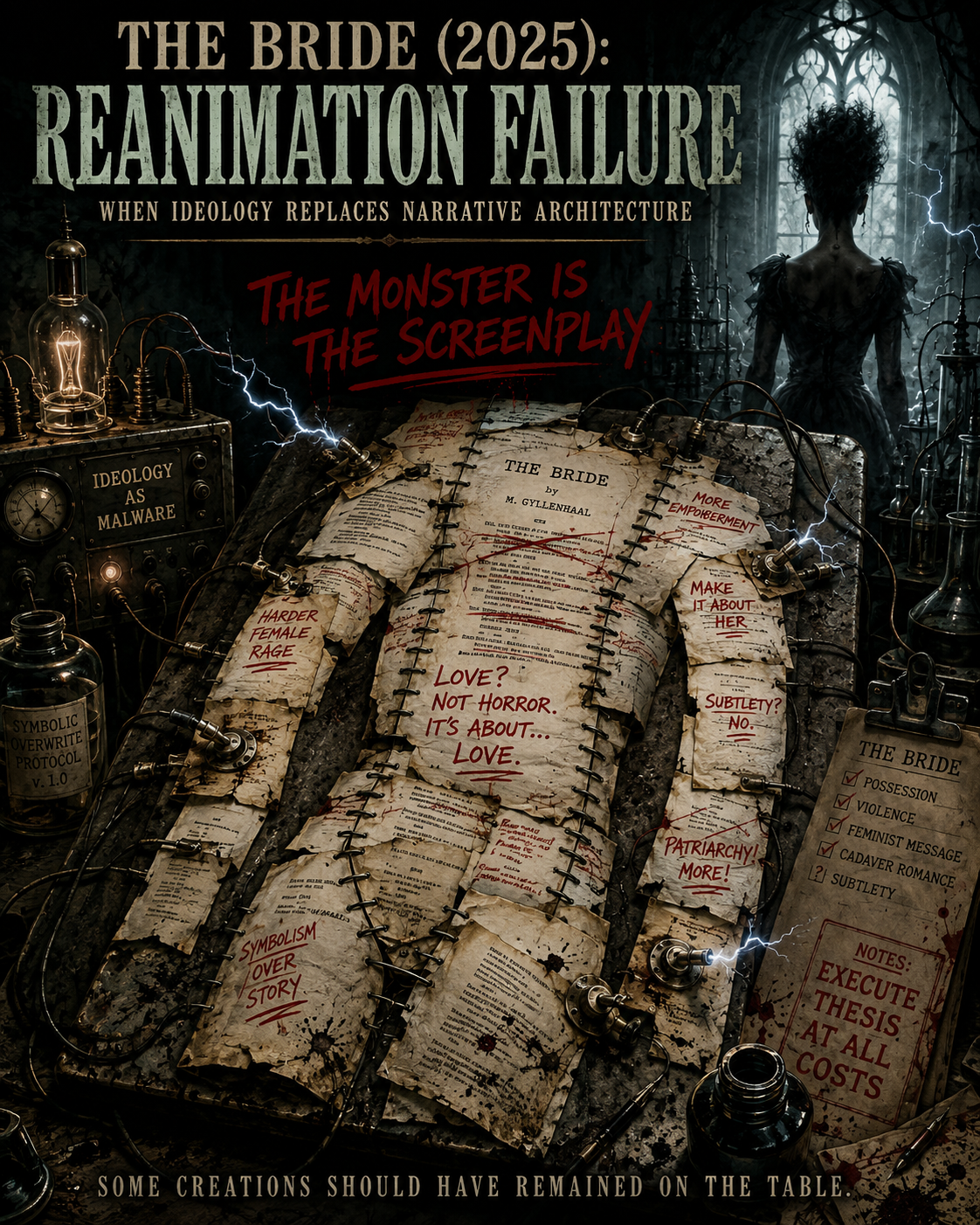
I went into The Bride with skepticism.
Not cautious optimism.
Not open-minded curiosity.
Skepticism.
Because on paper, the pitch appears to be:
“What if Frankenstein and his Bride became Bonnie and Clyde in Depression-era America, but ideological?”
Which is already dangerous.
Not because reinterpretation is bad. Reinterpretation can be excellent.
But because certain pitches emit immediate developmental distress signals.
This was one of them.
Within minutes, that skepticism was not merely validated.
It was professionally affirmed.
Because The Bride is, at least initially, a film patched together with less structural coherence than Frankenstein’s actual creature.
Which is almost impressive.
Let us begin.
For reasons never meaningfully explained, Mary Shelley appears trapped in some kind of metaphysical purgatorial holding cell.
Why?
Unknown.
What are the rules?
Unknown.
Why is she there?
Unknown.
Why is she so catastrophically angry?
Also unknown.
And not ordinary anger.
Not existential sorrow.
Not tragic literary melancholy.
No.
This is full theatrical supervillain rage.
Cackling, seething, reality-hating fury.
As though someone told Mary Shelley that Frankenstein had been adapted into a CW pilot and she never emotionally recovered.
Fine.
We continue.
Apparently, Mary’s plan—because yes, there is apparently a plan—is to re-enter reality by possessing another woman.
Why?
Still unclear.
But ideology does not wait for clarity.
So she targets Ida (Jessie Buckley), who is attending what appears to be a deeply suspicious dinner party populated by profoundly unpleasant men.
The atmosphere says:
something is wrong.
The screenplay says:
please remain seated while we aggressively explain our thesis.
Soon we discover Ida is undercover, helping authorities expose a mob-adjacent predator ecosystem involving violence against women.
Subtlety has already left the building.
And the mob boss—let us speak plainly—appears styled with the visual nuance of:
“What if Harvey Weinstein, but make it period costume?”
At this point, the film is no longer communicating through story.
It is communicating through symbolic blunt-force trauma.
Which can work.
If attached to a functioning narrative organism.
This is where complications begin.
Mary Shelley—now operating less like literary consciousness and more like malicious metaphysical malware—enters Ida’s psychological infrastructure.
And here, briefly, I became interested.
Because Horror Processing understands possession not merely as supernatural invasion, but as hostile systems overwrite.
Identity corruption.
Administrative seizure of selfhood.
That’s a real idea.
A good one.
Unfortunately, the film handles it with all the restraint of someone emptying a thesaurus into a cement mixer.
Ida begins violently oscillating between personalities.
One moment:
working-class New York instability.
The next:
hyper-articulate British intellectual diction.
Then back.
Then forward.
Then verbal overproduction so aggressive it feels like someone liquefied an Oxbridge library and poured it directly into dialogue.
Nobody understands what is happening.
Which, to be fair, creates solidarity between characters and audience.
The dinner table descends into confusion.
Music stops.
Reality wobbles.
Ida publicly detonates.
And I found myself asking a simple question:
Is this deliberately incoherent?
Or merely incoherent?
This distinction matters.
Chaos can be productive.
Disorientation can be intentional.
Systems collapse can be narratively meaningful.
But only if the film understands the architecture it is breaking.
At this point, The Bride does not inspire confidence.
It inspires concern.
Not horror.
Concern.
Then the film introduces what appears to be its first major thesis contribution:
male crisis management, cinematic edition.
Ida—currently undergoing catastrophic metaphysical systems corruption—is escorted into the stairwell by men whose emotional response protocol appears to have been downloaded from:
PATRIARCHY.EXE (Legacy Build).
Their diagnosis?
Woman distressed.
Their treatment plan?
Slappy Slap™
Followed, naturally, by:
Additional Slappy Slap™
Because apparently emotional regulation in this universe is achieved through impact-based calibration.
Meanwhile Mary Shelley—who has demonstrated the strategic foresight of ransomware written by a drunken Victorian literature major—decides that while inhabiting Ida’s body, the optimal move is to mock the genital dimensions of one of the large mob-affiliated underlings.
An interesting tactical choice.
Predictably, this leads to:
more Slappy Slap™
followed by:
Tossy Toss™
Ida falls.
Breaks.
Collapses at the bottom of the stairs like a shattered marionette.
And here one must pause to admire Mary Shelley’s operational genius.
Her objective:
re-enter reality.
Her method:
destroy the only functioning human vessel enabling re-entry.
Excellent systems planning.
At this point, the film introduces Frankenstein.
And I asked myself:
Will Maggie Gyllenhaal attempt a visually original reinterpretation of one of horror’s most iconic figures?
Reader:
she will not.
Instead, the design philosophy appears to be:
“What if Universal Studios Halloween rental package, but prestige-adjacent?”
Flat head?
Check.
Greenish pallor?
Check.
Forehead sutures large enough to survive orbital imaging?
Check.
It is less reinterpretation than affectionate costume-party compliance.
Frankenstein enters.
Meets a conveniently available mad scientist.
And the exchange is roughly:
“Hello, I am Frankenstein.”
“Oh yes, I’ve heard of you.”
“Please make me a companion.”
“Why?”
“Sex.”
At which point I experienced the first of several spiritually significant eye-rolls.
Because one immediately fears:
Ah. So this is going to be that kind of film.
And then, unexpectedly—
briefly—
Christian Bale introduces something real.
Loneliness.
Isolation.
Existential incompatibility.
The horror of conscious existence without relational correspondence.
And the Horror Processor, against all odds, stirred.
Because this is Frankenstein.
Not ideology.
Not slogans.
Not decorative thesis deployment.
But existential systems failure:
a conscious being structurally incompatible with the world that produced him.
That is rich material.
That is human.
That is horror.
And for approximately six minutes, one suspects the film may actually pivot toward meaningful analysis.
This hope proves unwise.
Because instead, resurrection is solved with astonishing efficiency.
The original Victor Frankenstein spent narrative eternity wrestling with forbidden science, theological arrogance, and the impossibility of reanimation.
This version?
Weekend side project.
Dig up Ida.
Bring body to lab.
Flip switch.
Bingo bango resurrection achieved.
No scientific struggle.
No metaphysical cost.
No dramatic architecture.
Just electrical confidence.
And because originality remains under strict supervision, resurrection also produces:
The Bride Hair™
Yes.
That hair.
The one everyone knows.
Vertical electro-trauma chic.
As though she briefly served aboard the Space Shuttle before returning for principal photography.
Again:
not reinterpretation.
Brand compliance.
Then:
black liquid vomiting.
Why?
Unknown.
Does anyone hand her a cloth?
Yes.
Does she wipe her face?
No.
Because apparently this residue must remain permanently, eventually evolving into revolutionary symbolic face paint as women later adopt the look while violence escalates and the patriarchy commentary intensifies.
At this point, coherence has entered witness protection.
Then the Bride, newly alive, makes her first major autonomous desire known.
Not identity.
Not meaning.
Not existential reconciliation.
No.
She wants to attend what can only be described as a:
depression-era industrial sex rave.
A remarkable sentence to type in a Frankenstein review.
She dances.
Explores sensuality.
Fine.
Actually, potentially interesting.
Then a man crosses consent boundaries.
She resists.
Frankenstein intervenes.
The men retaliate.
The film enters attempted assault territory.
Frankenstein responds by crushing skulls.
Double homicide achieved.
And here, in a rational narrative, Frankenstein might conclude:
Perhaps existential loneliness is preferable to whatever this is.
Perhaps there are quieter hobbies.
Birdwatching.
Wood carving.
Advanced correspondence chess.
Instead, having witnessed approximately twelve escalating red flags in under a day, Frankenstein decides:
No. This feels promising.
Christian Bale plays the character with the bewildered romantic determination of a graduate student emotionally attached to a disastrous thesis topic.
Which brings us to the film’s actual romantic architecture:
Emergency Himbo Infrastructure™
A relationship model in which the male lead is not required to possess coherent judgment, emotional nuance, or self-preservation instincts—
provided he remains physically deployable for emergency blunt-force intervention.
And off they go.
Zombie Bonnie and Clyde.
Pursued by incompetent authorities and a mob boss whose symbolic coding remains all the subtlety of a brick through stained glass.
At which point the film’s initial pitch completes its self-fulfilling prophecy.
Yes.
It was, in fact, exactly that stupid.
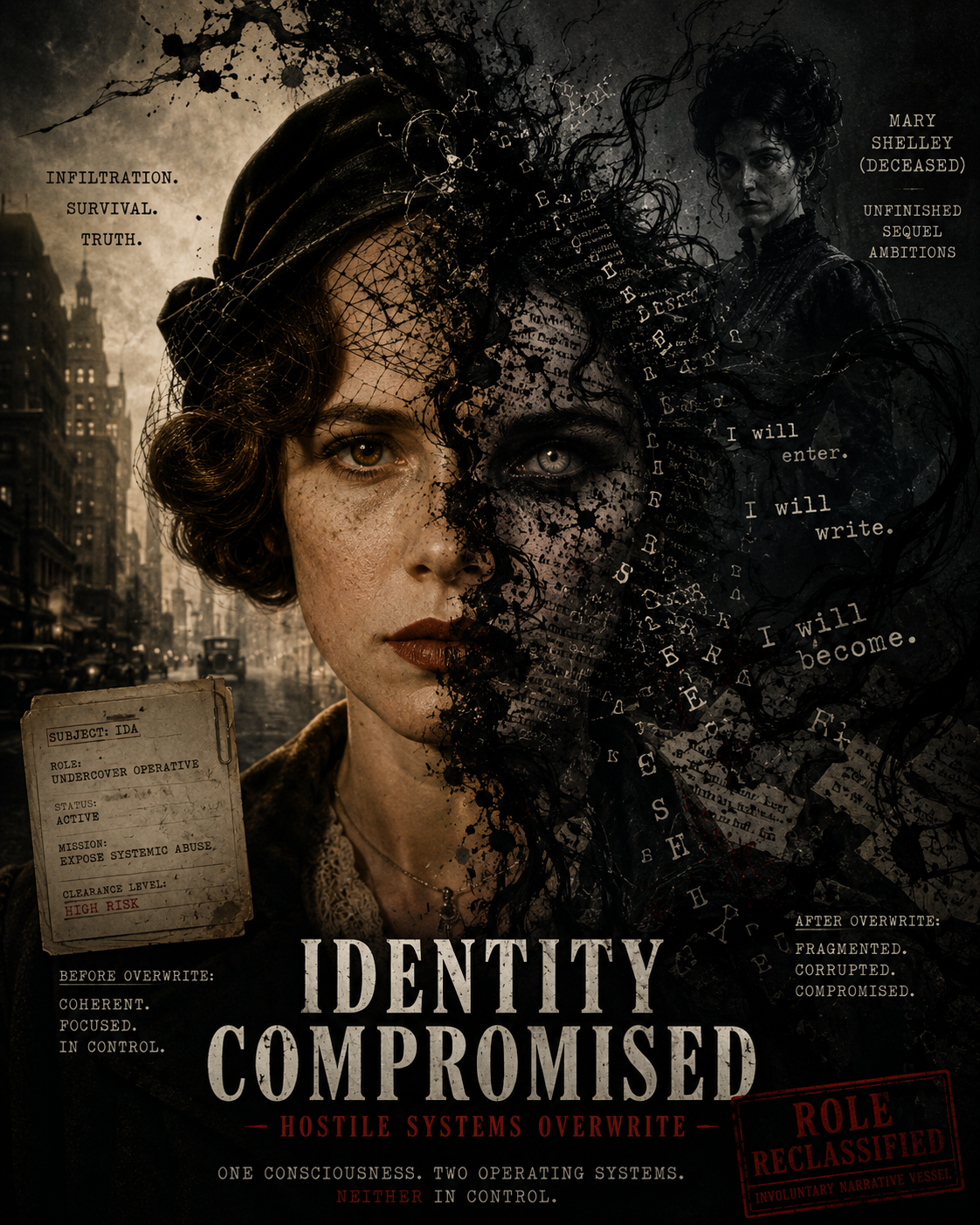
PART II: THE ONLY OPERATIONAL SUBSYSTEM
Jessie Buckley Survives the Processing Event
For all my contempt toward The Bride, fairness requires precision.
Because amid this structurally unstable ideological cadaver, one subsystem remains impressively functional:
Jessie Buckley.
This matters.
Criticizing a failed film does not require pretending nothing works.
Something absolutely works here.
Jessie Buckley appears to understand that she has entered collapsing narrative architecture and responds not by surrendering—but by acting harder.
Which deserves respect.
Because Ida is, from a Horror Processing perspective, actually fascinating.
Before Mary Shelley’s metaphysical intervention, Ida is at least participating in an intelligible narrative.
Dangerous, yes.
But coherent.
Undercover woman infiltrates violent male criminal infrastructure to expose systemic abuse.
Simple.
Functional.
Clear stakes.
Then a dead novelist trapped in inexplicable purgatory decides:
No. I need this one.
And Ida’s entire operating system gets overwritten.
Which is, honestly, one of the funniest accidental Horror Processing concepts in recent cinema.
Imagine already being trapped in your own dangerous storyline—
only to be forcibly recruited into the unfinished sequel ambitions of a dead author having what appears to be an eternity-induced psychotic break.
Ida is not merely possessed.
She is narratively hijacked.
Administrative reassignment at the metaphysical level.
Somewhere, some cosmic clerk stamps her paperwork:
ROLE RECLASSIFIED.
Suddenly Ida is no longer:
woman infiltrating criminal patriarchy.
She is now:
involuntary vessel in Mary Shelley’s underdeveloped posthumous fan fiction.
That is both horrifying and weirdly hilarious.
Because if Horror Processing teaches us anything, it is this:
being trapped in reality is already difficult enough without discovering your reality has been purchased by external narrative management.
And Buckley sells this.
That’s the remarkable part.
Because this kind of possession performance could become unbearable very quickly.
Instead, Buckley makes Ida’s fragmentation genuinely compelling.
The tonal shifts.
The linguistic instability.
The abrupt oscillation between selves.
That extraordinary sense that one consciousness is looking out through another’s face while neither fully controls the machinery.
It works.
Not because the screenplay earns it.
Because Buckley commits completely.
There is a particular expression she deploys—half mischievous child, half entity that has reviewed all available human documentation and remains profoundly unimpressed—that becomes weirdly magnetic.
A look that says:
I know something you do not.
Or perhaps:
I am something you cannot categorize.
Which is infinitely more interesting than much of the surrounding film.
Even when the dialogue devolves into what sounds like an overcaffeinated Oxford dictionary experiencing a nervous breakdown, Buckley maintains control.
Or at least the illusion of it.
Which, in this film, qualifies as extraordinary professionalism.
And this is where the Horror Processor becomes genuinely interested.
Because what the film accidentally stumbles into is not possession.
It is:
hostile systems overwrite.
Identity corruption.
Narrative malware.
Consciousness invasion.
Ida is less haunted than administratively compromised.
Her core operating system has been infiltrated by a furious nineteenth-century literary intelligence with unresolved sequel ambitions.
That is gold.
A much better film exists inside that premise.
A film about autonomy violation.
About inherited narratives overwriting identity.
About being forced into symbolic architecture not of your choosing.
About becoming a puppet inside someone else’s recursive literary obsession.
Jessie Buckley appears to understand that film.
It is less clear whether The Bride does.
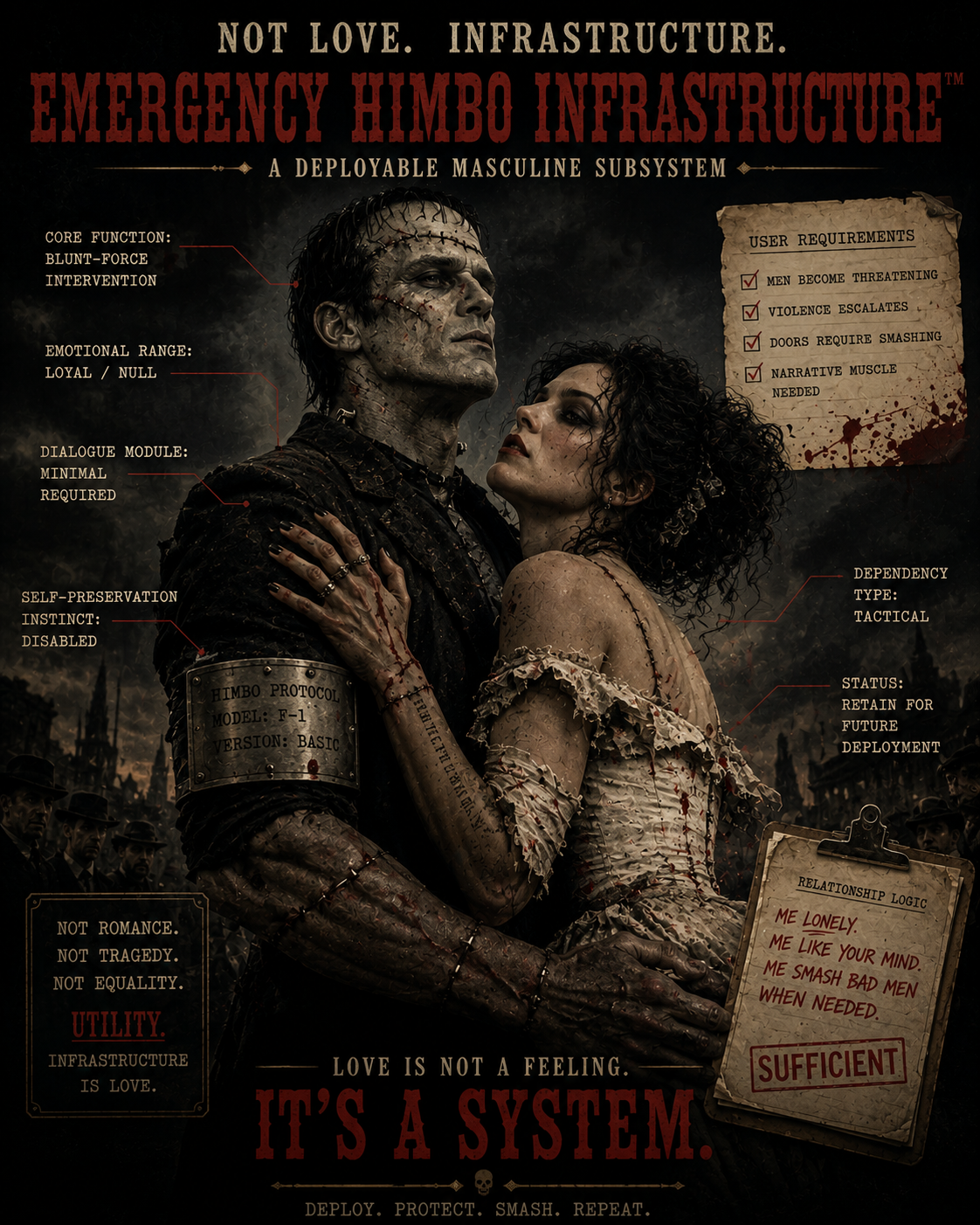
PART III: EMERGENCY HIMBO INFRASTRUCTURE™
When Love Becomes Deployable Systems Architecture
Early in the film, The Bride attempts to announce its own thematic seriousness through Mary Shelley, who—while apparently trapped in some sort of Victorian purgatorial grievance chamber—essentially asks:
“But what if this is not horror? What if this is… love?”
Cue ominous theatrical cackling.
Nothing inspires confidence quite like a psychotic dead author explaining the theme before the story has begun.
That is always a healthy sign.
It is the cinematic equivalent of a chef arriving at your table before appetizers and announcing:
“Just so you know, this meal is actually about transcendence.”
No.
Please leave.
Let the food defend itself.
And yet The Bride insists.
This, we are told, is not horror.
It is love.
Which is a bold declaration for a film that proceeds to feature:
- metaphysical possession
- identity overwrite
- homicide
- attempted assault
- ideological narrative malware
- cadaver resurrection
- escalating psychological instability
But yes.
Love.
Certainly.
And to be fair, the film does eventually reveal its relationship model.
It is not tragic Gothic longing.
Not existential companionship between fractured consciousnesses.
Not the unbearable hope of two incompatible beings reaching toward mutual recognition.
No.
The Bride proposes something much more contemporary:
Emergency Himbo Infrastructure™
A relationship architecture in which the male lead is not required to possess psychological depth, emotional nuance, coherent judgment, or even especially compelling dialogue—
provided he remains physically deployable for emergency blunt-force intervention.
Christian Bale’s Frankenstein is not really written as tragic existential consciousness.
He is written as romantically activated support equipment.
The governing logic appears to be:
Me lonely.
Me like your mind.
Me smash dangerous men when needed.
And apparently, this is sufficient.
The relationship unfolds with astonishing efficiency.
The Bride declares independence.
Belongs to no one.
Rejects ownership.
Creates chaos wherever she goes.
Generates escalating homicide exposure.
Threatens departure whenever emotional complexity threatens to produce actual character development.
Frankenstein’s response?
Unwavering devotion.
No boundaries.
No self-preservation.
No reflective existential recalibration following multiple catastrophic incidents.
Just loyal shambling emotional commitment.
Which would be touching if it were not so profoundly stupid.
At several points, a rational being might conclude:
Perhaps relational compatibility has not been achieved.
Perhaps existential loneliness remains preferable.
Perhaps birdwatching.
Instead, Frankenstein remains fully committed to what can only be described as catastrophic attachment.
And then the film reveals the actual relationship logic.
Not romance.
Utility.
Because when Frankenstein is later incapacitated, The Bride suddenly discovers that perhaps the large, loyal, emotionally uncomplicated homicide-adjacent companion had strategic value after all.
Not necessarily husband value.
Certainly not equal partner value.
But definite:
retain-for-future-deployment value.
And so the architecture becomes clear.
Not Gothic romance.
Not tragic companionship.
Not existential union.
But:
Tactical retention of Emergency Himbo Infrastructure™.
A deployable masculine subsystem.
Useful when:
- men become threatening
- violence escalates
- doors require smashing
- narrative muscle becomes operationally desirable
One hesitates to call this romance.
It feels closer to infrastructure leasing.
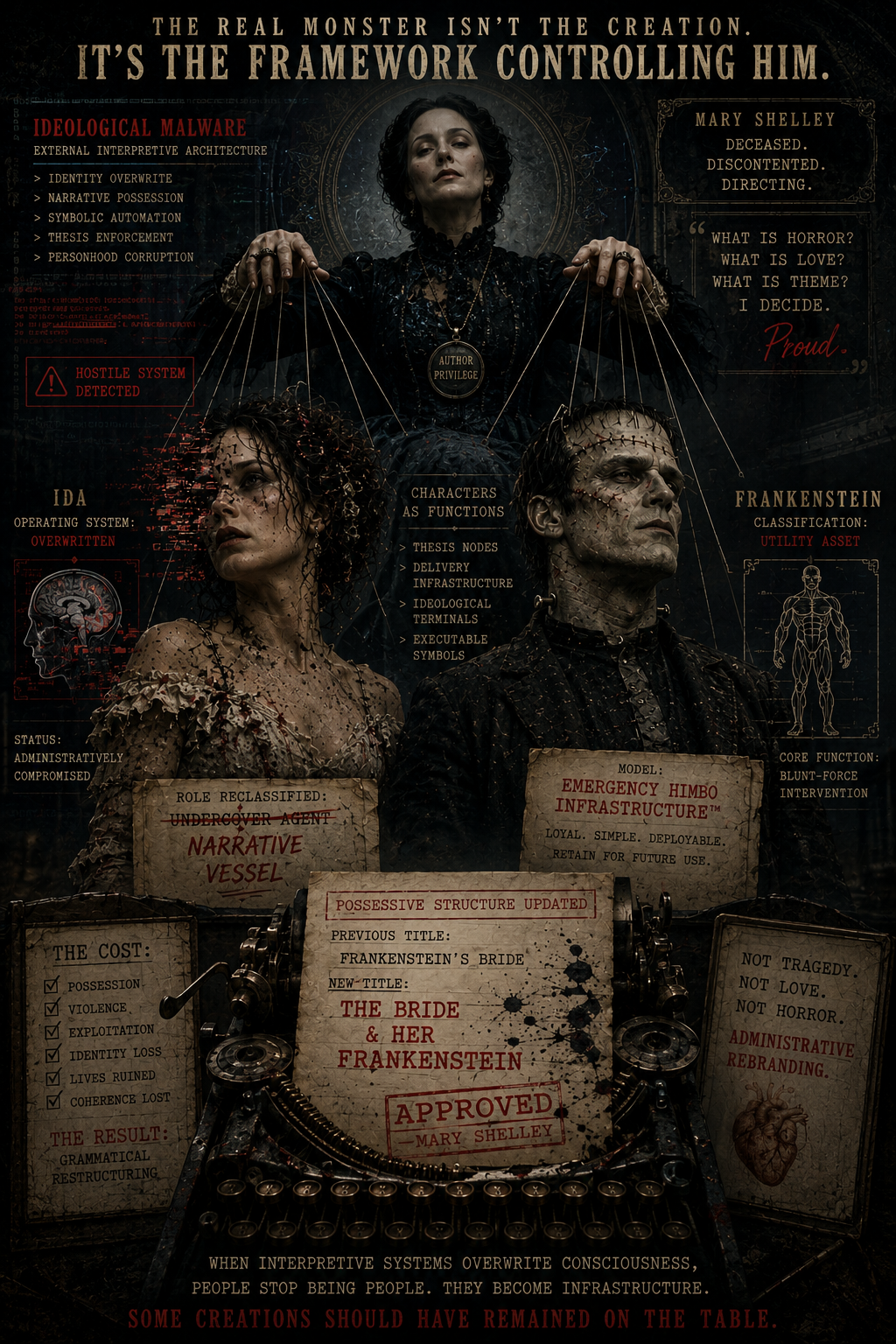
PART IV: IDEOLOGICAL MALWARE
When Narrative Consciousness Is Overwritten
The sharpest Horror Processing insight in The Bride is also, perhaps, entirely accidental.
Because the real horror here is not Frankenstein’s creation.
It is narrative consciousness being overwritten.
Frankenstein, as a myth, should be rich Horror Processing territory.
Existential loneliness.
Creator/creation rupture.
Identity instability.
Autonomy violation.
Body horror.
Systems incompatibility.
The unbearable burden of consciousness without belonging.
This is fertile material.
Instead, The Bride repeatedly behaves as though characters are not people, but delivery systems for preloaded ideological messaging.
And that is where the true systems-horror reading emerges.
Because horror does not begin merely when bodies are controlled.
It begins when interpretive architectures overwrite personhood.
That is malware.
Characters stop behaving like psychologically coherent beings.
They become:
thesis nodes.
Symbolic delivery infrastructure.
Ideological terminals.
And suddenly, the film becomes far more interesting than it intends to be.
Because Ida experiences this literally.
Mary Shelley invades her consciousness.
Her operating system is overwritten by an external intelligence with unresolved authorial ambitions.
But on the meta-level, the exact same thing happens to the entire film.
The possession is not merely plot.
It is structure.
Characters cease functioning as autonomous beings.
They become executable functions.
Interpretive possession.
Narrative overwrite.
Symbolic automation.
Even Frankenstein himself becomes evidence.
Emergency Himbo Infrastructure™ is funny.
But it is also revealing.
Because Frankenstein does not feel written as a psychologically coherent consciousness.
He feels pre-processed.
A masculine utility object.
A deployable blunt-force subsystem.
A thesis delivery mechanism disguised as character.
Which accidentally exposes the film’s deeper architecture.
Because what if ideology itself behaves like malware?
Not as political disagreement.
As narrative structure.
An external interpretive system entering a story, overwriting complexity, and converting human beings into symbolic machinery.
That is genuine Horror Processing territory.
And for some reason—and I say this with genuine anthropological confusion—the film concludes with Mary Shelley appearing… proud.
Proud.
As though this catastrophe represents artistic triumph.
After:
- possession
- identity overwrite
- homicide
- exploitation
- narrative incoherence
- ideological malware deployment
- multiple ruined lives
- Emergency Himbo Infrastructure™ collapse and reactivation
Mary Shelley effectively announces her grand accomplishment:
This is no longer:
Frankenstein’s Bride.
It is now:
The Bride and Her Frankenstein.
Pause.
That is the climactic revelation?
Countless human beings were psychologically, physically, and narratively pulverized so that a dead author trapped in metaphysical purgatory could reorganize the possessive pronouns in an already profoundly dysfunctional cadaver relationship?
That was the objective?
That was the thesis?
That was the win condition?
Because if so, The Bride may have accidentally invented a new subgenre:
linguistic ownership horror.
The true monster was apparently grammar.
And in a strange way, this perfectly completes the film’s accidental Horror Processing thesis.
Because The Bride is fundamentally about systems overwrite.
Mary Shelley invades Ida.
Ideology invades narrative.
Characters cease functioning as autonomous consciousnesses and become symbolic infrastructure.
Reality bends toward thesis enforcement.
And in the end, after all the carnage, the revelation is not emotional.
Not philosophical.
Not tragic.
It is administrative.
A title reassignment.
A branding correction.
A metaphysical HR memo:
POSSESSIVE STRUCTURE UPDATED
Which may be the most Horror Processing ending imaginable.
Not because it is horrifying.
Because it accidentally reveals the true architecture of the film.
This was never about people.
It was about ownership of narrative framing.
And after two-plus hours of chaos, ideological possession, homicide, cadaveric dysfunction, and symbolic systems failure, one can only conclude:
some creations should have remained on the table.