MARTYRS and the Administrative Logic of Suffering: Leatherface Gets an MBA
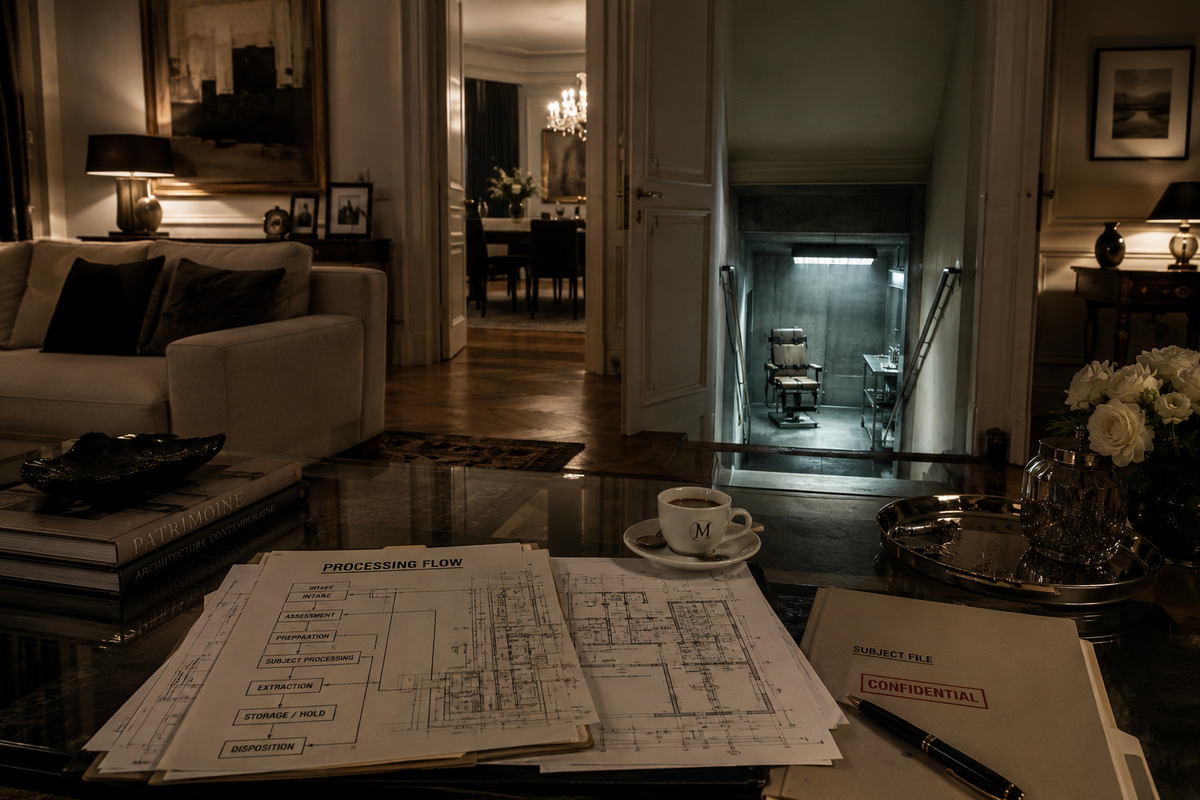
Martyrs essentially begins where The Texas Chain Saw Massacre ends.
A screaming, blood-soaked girl escapes a hidden human processing architecture and stumbles into daylight.
Only this time, the nightmare did not stay in rural Texas.
It got educated.
It got an MBA.
Somewhere between Leatherface’s slaughterhouse and the French suburbs, the family business apparently underwent professionalization. One imagines Leatherface fathered a child, sent him abroad on a student exchange programme, and decades later that child returned as a financially successful attorney with impeccable taste in property.
Oui, he might say, standing in a tasteful suburban kitchen over espresso.
This should do nicely for continuation of legacy operations.
No screaming generators.
No bone furniture.
No overt cannibal theatrics.
Just clean walls, financial solvency, and efficient human processing.
Leatherface’s spiritual successors no longer wear faces or chase teenagers through fields.
They own property.
Very nice property.
In France.
Which matters.
Horror cinema has trained us to expect catastrophe in visibly damaged places.
Derelict rural Texas?
Obviously.
Cold War Berlin?
Certainly.
Places already coded as unstable, compromised, or historically contaminated.
But affluent suburban France?
That carries a far more dangerous cultural assumption:
surely these people have standards.
That is what makes Martyrs so structurally unsettling.
Because it performs a deeply disturbing inversion.
The Texas Chain Saw Massacre locates horror in rural collapse: heat, meat, decay, and a family that appears visibly deranged.
Martyrs asks a much nastier question:
What if the same machine were run by culturally sophisticated and administratively competent people?
The Opening Lie
Martyrs opens with architecture.
Not character.
Architecture.
Cold concrete.
Institutional corridors.
Brutalist containment spaces.
A terrified girl runs through an environment that does not feel domestic, accidental, or improvised. Blood runs down her body. She escapes into daylight looking less like a survivor than failed material expelled from a process.
The film immediately gives us a question:
What happened in that building?
And then, deceptively, it appears to answer.
The girl is Lucy.
She grows up in an orphanage, befriends Anna, and the film appears to settle into familiar psychological horror territory: trauma, damaged identity, unresolved abuse.
Police interviews.
Self-harm.
Fragmented memory.
Lucy insists:
It wasn’t me.
Then comes the classic horror grammar.
Night.
Bedroom.
A grotesque woman.
Something in the room.
Something on the bed.
Excellent.
We know this movie.
Trauma victim.
Possible demonic attachment.
Possible supernatural entity.
Possible psychotic break.
Standard genre paperwork.
Then the creature appears properly, and the audience can relax.
Ah yes.
Of course.
Regan from The Exorcist grew up, got a passport, and relocated to France.
Everything makes sense.
Except it does not.
Because Martyrs is already lying to you.
Then the film performs its first major structural rupture.
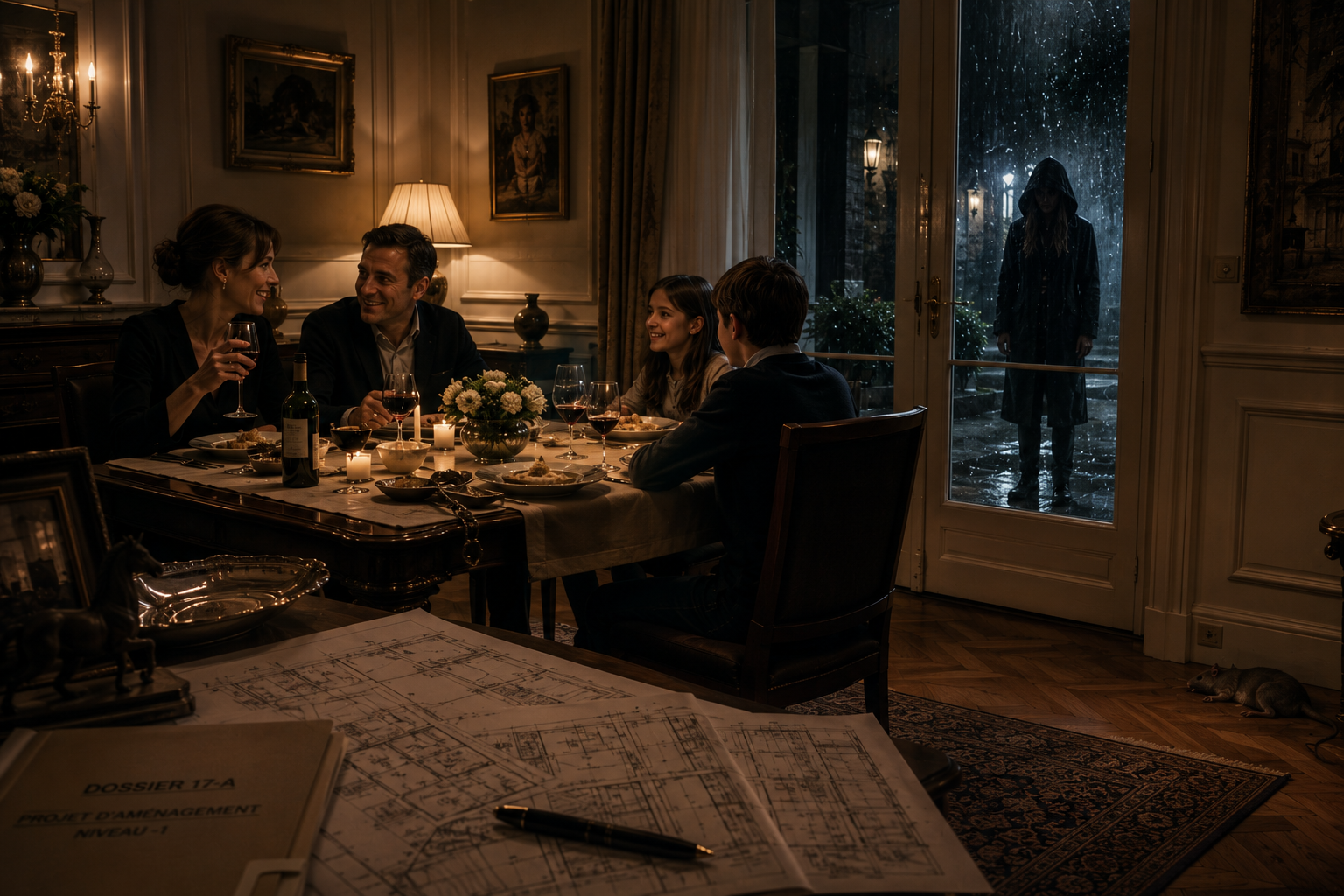
Cut to an affluent suburban French home.
Tasteful interiors.
Educated parents.
Well-behaved children.
Professional-class normalcy.
The son casually mentions not wanting to become a lawyer.
Reasonable.
The mother discovers a dead mouse in the plumbing.
Mildly concerning.
The family laughs.
Deeply French, perhaps.
Aggressively ordinary.
Then the father answers the door.
“What a lovely surprise. A guest.”
Shotgun blasty blast™.
Lucy enters.
Older.
Traumatized.
Apparently armed with enough firepower to suggest that, alongside processing her childhood trauma, she also found time to maintain a subscription to Guns & Ammo.
She enters not as victim—
but executioner.
She murders the entire family with absolute conviction, demanding to know whether the children understand what their parents did.
At this point, interpretive collapse begins.
Is Lucy insane?
Delusional?
A murderer projecting trauma onto strangers?
Or horrifyingly correct?
Meanwhile Anna—arguably the most loyal best friend in horror history—waits outside, enters the murder house, discovers multiple corpses, and essentially responds:
Yes, this is catastrophic.
Yes, I will help you dispose of the bodies.
Because friendship requires flexibility.
Which is honestly admirable.
Then Lucy’s monster returns.
The childhood monster.
Regan on metaphysical steroids.
Still spider-adjacent.
And Martyrs doubles down on the misdirection.
The creature is gaunt.
Violent.
Animalistic.
Inhuman.
A perfect trauma demon.
Exactly the kind of entity designed to reassure the audience:
Ah. I understand. This is that kind of horror film.
It is not.
That is the trick.
Because Martyrs spends its first act encouraging the audience to misclassify reality.
Supernatural horror.
Possession narrative.
Trauma psychosis.
Revenge thriller.
Pick your category.
All incorrect.
Because what initially appears to be a story about private damage is actually something much colder.
Something organized.
Something architectural.
The house is not merely a murder scene.
It is an interface.
We just do not know that yet.

The Processing Floor
Up until this point, Martyrs remains technically interpretable.
Lucy may be insane.
The family may be innocent.
The creature may be supernatural.
Anna may simply be making historically poor friendship decisions.
All possibilities remain open.
Then Anna discovers the woman in the basement.
And the entire film reclassifies.
Not because the “monster” was real.
It was not.
That matters.
Lucy’s creature is best understood as trauma externalized.
Survivor guilt given form.
A psychic wound with extremely aggressive practical makeup.
As a child, Lucy escaped unimaginable abuse.
But she also witnessed another imprisoned girl she could not save.
That unresolved guilt metastasized.
The monster is not a demon.
It is Lucy’s inability to process survival.
Which means the first act’s genius is subtler than a simple fake-out.
Lucy is not “crazy.”
She is psychologically shattered.
But she is also fundamentally correct.
That distinction matters.
Because the audience makes the same mistake Lucy does.
Lucy misclassifies trauma as a monster.
We misclassify Lucy as unstable.
Both responses orbit a reality neither fully understands.
Then the basement victim appears.
And suddenly the entire interpretive framework collapses.
Because this is the moment Martyrs quietly says:
No, Lucy was not hallucinating the existence of a hidden system.
She was misprocessing a real one.
And oh yes.
The perfect suburban family?
They absolutely tortured her.
Those innocent children at breakfast?
Fully aware.
Martyrs casually detonates the audience’s moral assumptions, then keeps moving.
Lucy was right.
The family was guilty.
The monster was psychological.
The system was real.
Mic drop.
And then the protagonist dies.
Which is, structurally speaking, rude.
Because Lucy appears to be the narrative center.
Traumatized survivor.
Revenge engine.
Primary subject.
Nope.
Function transferred.
Anna inherits the role.
Not as heroine.
Not as rescuer.
As replacement material.
Which brings us to the house.
Ah yes.
The tasteful suburban French family home.
Good schools.
Likely excellent property taxes.
Strong wine storage.
Minor plumbing concerns.
It turns out this was not primarily a home.
It was infrastructure.
That is the crucial shift.
Because horror houses are usually symbolic.
Haunted spaces.
Psychological projections.
Places where trauma manifests.
Martyrs says:
No.
This one has operational purpose.
The basement is not metaphorical.
Not “the unconscious.”
Not buried guilt.
Not repressed memory architecture.
It is an actual working chamber.
A concealed processing environment.
That distinction is what makes the film so nasty.
The home was not corrupted.
The home was designed.
And the moment Anna enters that lower level, the narrative performs a transfer.
Lucy, for all practical purposes, is finished.
Anna becomes the new subject.
This is where Martyrs becomes true systems horror.
Then the organization arrives.
And this is where the film’s temperature changes completely.
Because had the basement door burst open and revealed cackling maniacs in masks, we would remain in familiar territory.
Leatherface’s unsettling French exchange students.
Fine.
Instead, what arrives is far worse:
administration.
Order.
Procedure.
People who look like they arrived on schedule.
No theatrical sadism.
No wild-eyed mania.
No improvised evil.
Just calm operational competence.
That is infinitely more disturbing.
Because chaotic violence feels exceptional.
Structured violence feels sustainable.
And sustainable violence is always scarier.
The hidden genius of Martyrs is that it begins by asking whether Lucy is psychologically unstable.
Then reveals the far more horrifying possibility:
Lucy correctly identified a functioning institution.
Not a ghost.
Not a demon.
Not random cruelty.
A system.
And systems are much harder to kill.
The Bureaucracy of Transcendence
And then Martyrs reveals its final insult.
This was never merely about cruelty.
Cruelty is easy.
Cruelty is emotional.
Messy.
Improvised.
A person loses control.
A monster acts on appetite.
That is ordinary horror.
Martyrs proposes something much colder:
What if suffering became methodology?
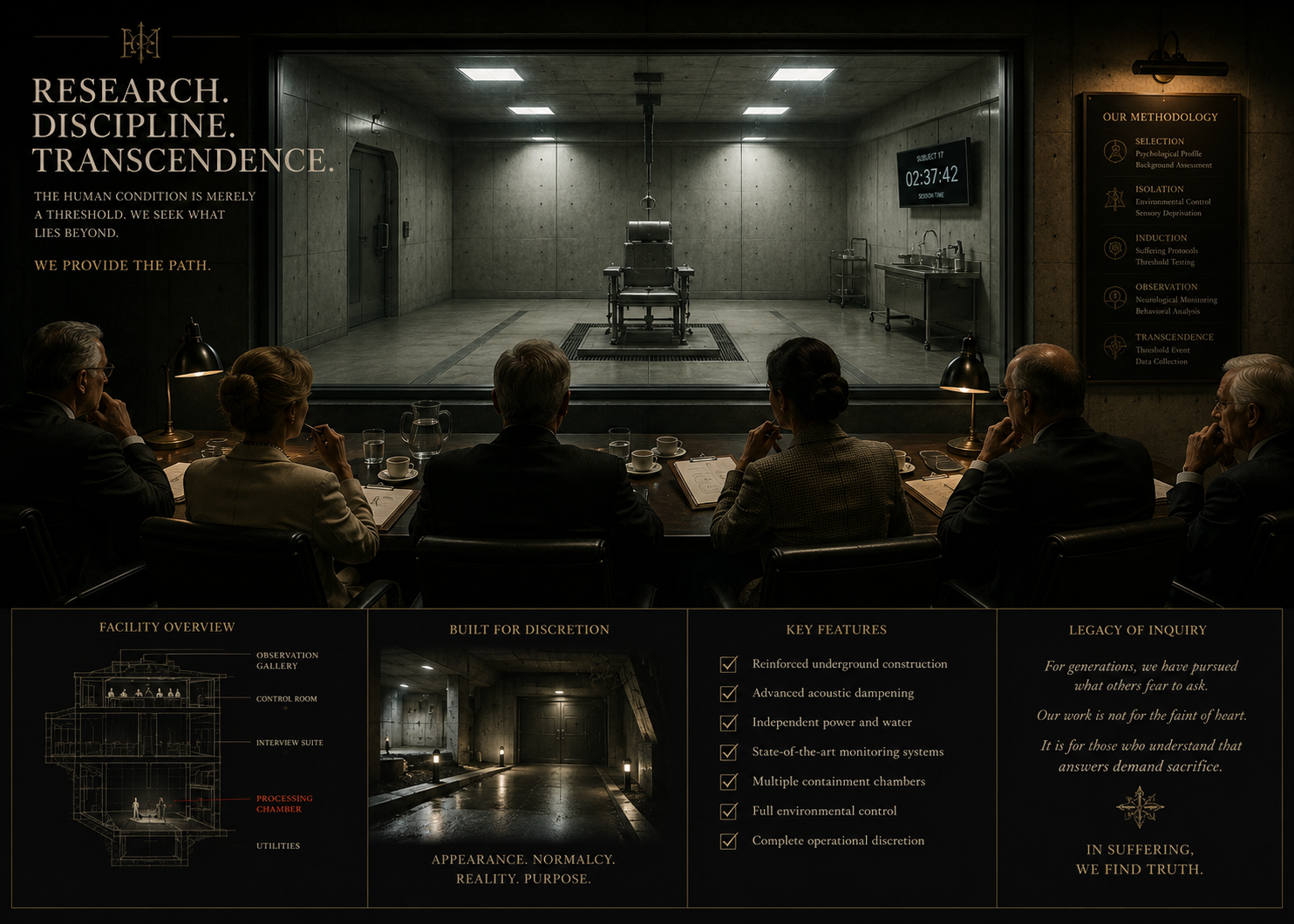
This is where the film fully mutates from extreme horror into systems horror.
Because the organization does not torture Anna for pleasure.
That distinction matters.
There is no cackling sadist.
No theatrical villain monologue.
No “you and I are not so different” nonsense.
No leather aprons.
No chainsaw fuel concerns.
This is not artisanal violence.
It is administrative.
The organization has a coherent metaphysical objective.
They believe extreme suffering can strip away the noise of ordinary consciousness.
Identity.
Memory.
Selfhood.
Fear.
Pain.
Everything.
Until the subject reaches a final threshold.
A state beyond ordinary perception.
Martyrdom, in their logic, is not religious symbolism.
It is information extraction.
That is what makes the premise so horrifying.
Human agony has been converted into research methodology.
The oldest human question—
What happens after death?
—has been handed to middle management.
And middle management, predictably, built infrastructure.
This is where Anna ceases to be a character in the conventional sense.
She becomes process material.
Input.
A consciousness subjected to controlled degradation.
And yes.
Leatherface’s descendants apparently retained at least one cherished family protocol:
de-skinning remains company policy.
Only now it has been rebranded.
French style.
No longer for decorative facewear.
Now for transcendence.
Which is somehow worse.
Because the violence in Texas Chain Saw feels chaotic.
Primitive.
Industrial, yes—but emotionally legible.
The violence in Martyrs feels sanitized.
Clinical.
Professional.
That distinction matters.
One family kills because they are monstrous.
This organization kills because they believe they are conducting serious inquiry.
That is much more dangerous.
Because ideology stabilizes atrocity.
And Anna’s final sequence is where the film becomes genuinely upsetting.
Not because of gore.
Because of operational logic.
Her suffering is procedural.
Measured.
Sustained.
Depersonalized.
No one is improvising.
No one is losing control.
This is simply what the workflow requires.
That is systems horror.
Then the final transformation.
Anna reaches the threshold.
Or appears to.
And here Martyrs makes its most brilliant move.
The film refuses spectacle.
No glowing heavens.
No demon reveal.
No metaphysical CGI explaining the afterlife.
Just Anna whispering something privately to Mademoiselle.
And suddenly the entire organization destabilizes.
That is extraordinary.
Because the whole machine was built for certainty.
For revelation.
For proof.
Instead, what arrives is ambiguity.
And ambiguity destroys systems built on totalizing belief.
Mademoiselle does not announce the truth.
Does not celebrate.
Does not publish findings.
Does not call a press conference.
She quietly removes herself from existence.
Which leaves us with the central horror.
What did Anna say?
And more importantly:
What kind of information destroys the institution built to obtain it?
That ambiguity is the correct ending.
Because Martyrs is not ultimately about the afterlife.
It is about systems of meaning.
About what human beings will build when uncertainty becomes intolerable.
The torture is horrifying.
But not the deepest horror.
The deepest horror is this:
A group of educated, organized, materially comfortable adults looked at the mystery of human mortality—
and built an operating model.
A budget.
A workflow.
A property acquisition strategy.
Likely quarterly planning.
That is the true nightmare.
Not suffering.
Administrative suffering.
Not cruelty.
Institutional cruelty.
Not madness.
Competence.
Because Martyrs asks the nastiest systems-horror question imaginable:
What if the people trying to solve the universe’s greatest mystery were not monsters?
What if they were simply well-organized?