THE EXORCIST: WHEN CONSENSUS REALITY FAILS
With The Texas Chain Saw Massacre, horror gives us practical advice.
Don’t go into the creepy house.
Don’t pick up strange hitchhikers.
If a man wearing someone else’s face appears with a chainsaw, your evening has concluded.
There are lessons there.
Actionable lessons.
But Texas Chain Saw also hints at something more unsettling.
That beneath ordinary American life—highways, family homes, roadside normality—something older, uglier, and far less civilized is already operating.
It never fully explains that architecture.
It just lets you smell it.
The Exorcist does something different.
It stops hinting.
It brings that hidden reality into plain view.
Because unlike Texas Chain Saw, what exactly is the preventative strategy here?
Don’t get possessed?
Avoid ancient Mesopotamian demons?
Exercise greater caution when evaluating your child’s imaginary friends?
This is what makes The Exorcist uniquely disturbing.
Its horror is not practical.
If Leatherface is after you, there are at least theoretical survival options.
Run.
Hide.
Make dramatically better life choices.
But if some ancient hostile metaphysical intelligence enters your reality through your child?
That is a different category of problem.
And that’s where most readings stop.
Possession.
Catholic horror.
Good versus evil.
All true.
But incomplete.
Because The Exorcist is doing something far more psychologically devastating.
The real horror is not simply that Regan is possessed.
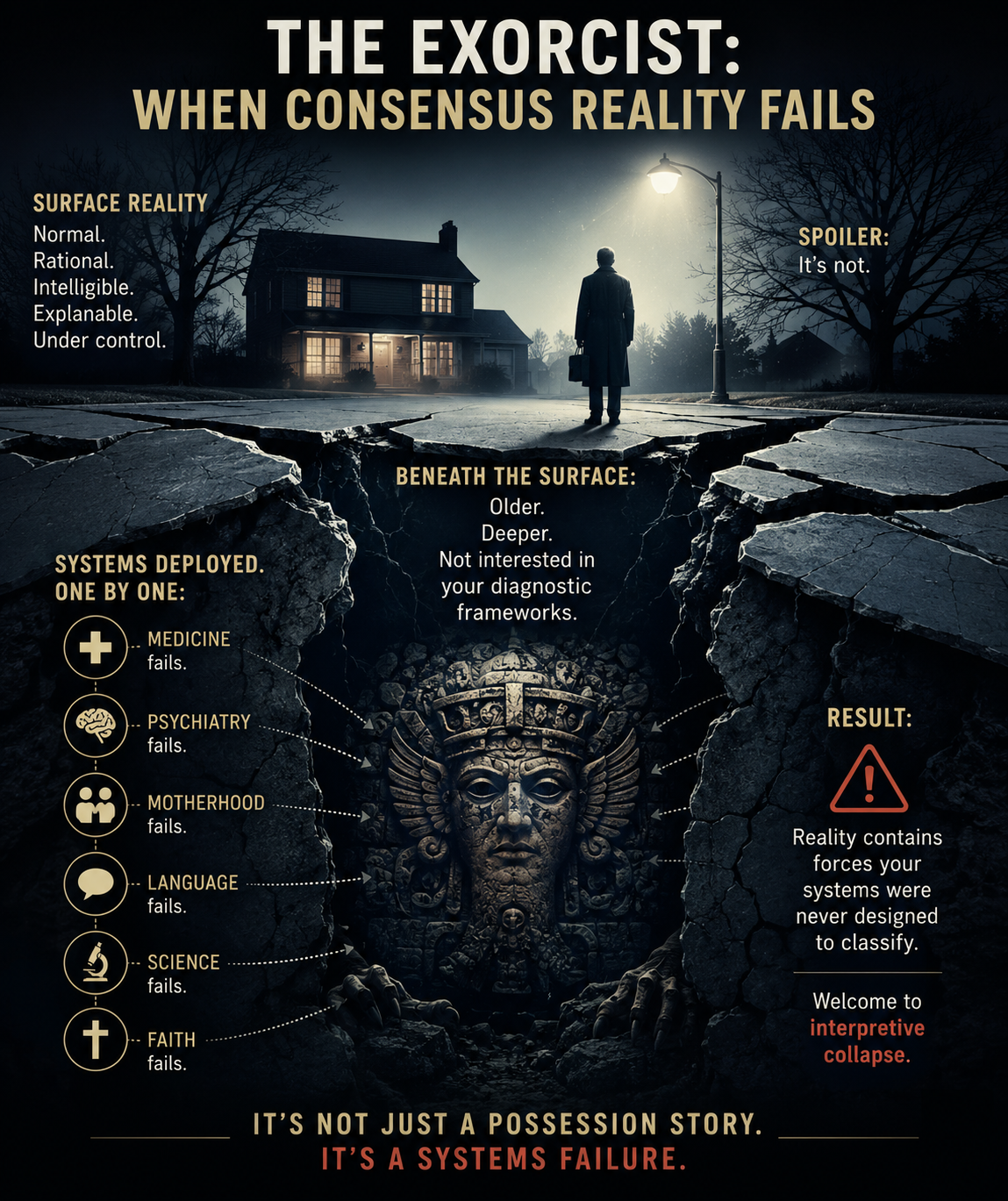
The real horror is watching every trusted human system for interpreting reality fail in sequence.
Medicine fails.
Psychiatry fails.
Motherhood fails.
Language fails.
Science fails.
Even faith initially fails.
And what remains is something more frightening than a demon:
the realization that reality contains forces our explanatory systems were never designed to classify.
That consensus reality may be thinner than we think.
And that beneath it, something has always been waiting.
CORE THESIS
At the surface level, The Exorcist is a possession film.
A demon enters a child.
Priests are summoned.
Faith confronts evil.
That’s the cultural shorthand.
But that misses what makes the film genuinely disturbing.
Because The Exorcist is not primarily about possession.
It is about interpretive collapse.
A systems failure.
And, strangely, that is exactly what makes it believable.
Because in a truly irrational world, this film lasts about fifteen minutes.
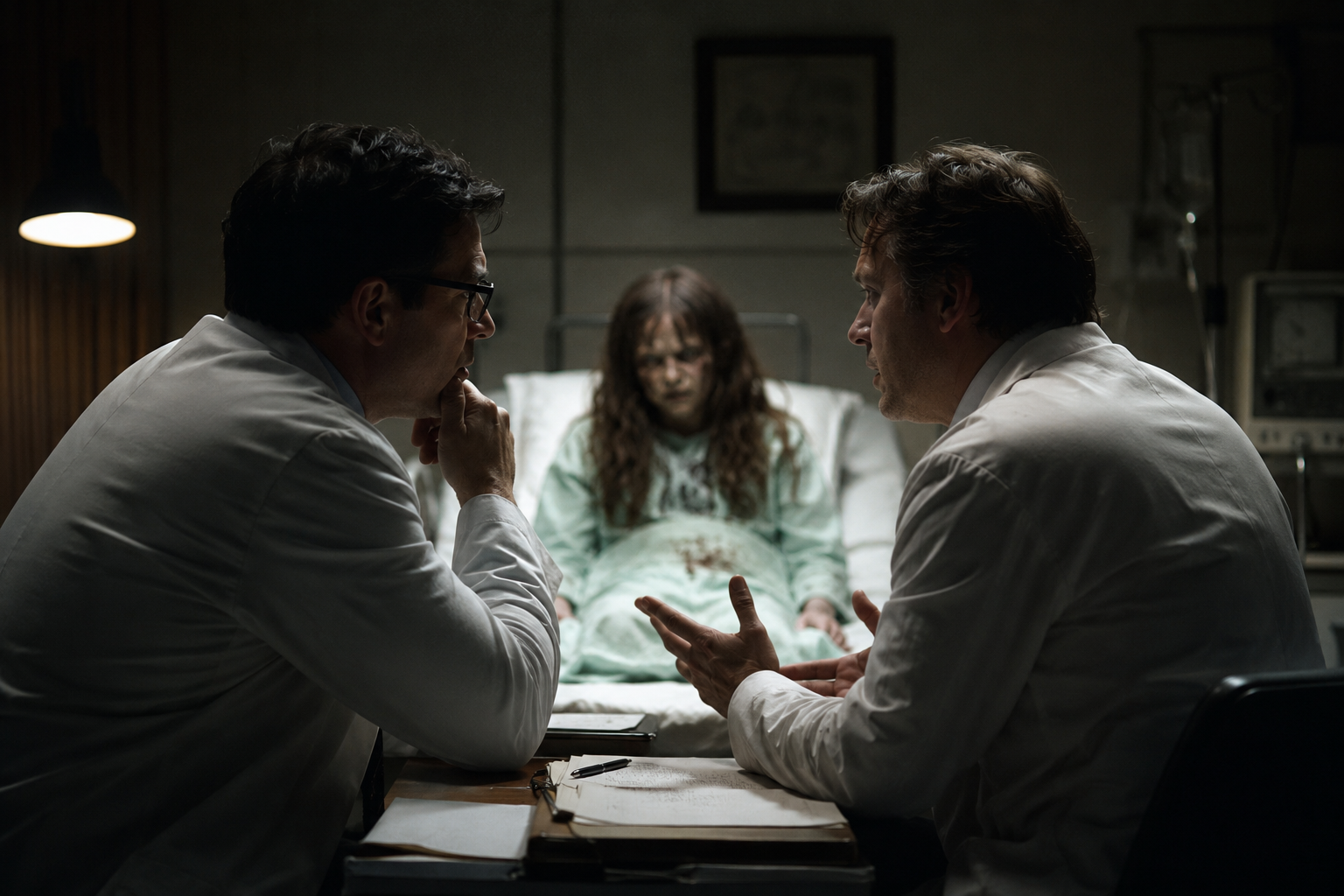
Imagine the consultation.
“Doctor, the scans came back.”
“Anything?”
“Nothing physically wrong.”
“Excellent.”
“Minor complication. She vomited green bile across the room while speaking in the voice of what sounds like a deeply aggrieved union truck driver.”
“…Go on.”
“Her bed was shaking.”
“Stress.”
“She demonstrated impossible knowledge.”
“Adolescence.”
“She assaulted multiple adults with inhuman strength.”
“Hormonal.”
“Her head rotated three hundred and sixty degrees.”
(long pause)
“Should we adjust the Ritalin?”
“No, doctor. This is clearly a demon.”
“Ah.”
“Of course.”
“Call an exorcist.”
End film.
But that is not how reality works.
Human beings do not leap to supernatural explanations.
Functioning societies certainly do not.
That is precisely what makes The Exorcist brilliant.
No one behaves irrationally.
Medicine behaves exactly as medicine should—
and fails.
Psychiatry behaves exactly as psychiatry should—
and fails.
Rational interpretation behaves rationally—
and fails.
The horror is not stupidity.
The horror is competent systems encountering something they cannot classify.
That is why The Exorcist endures.
Not because of possession.
Because it stages the collapse of explanatory reality itself.
PART I — IRAQ / INFRASTRUCTURE INITIALIZATION
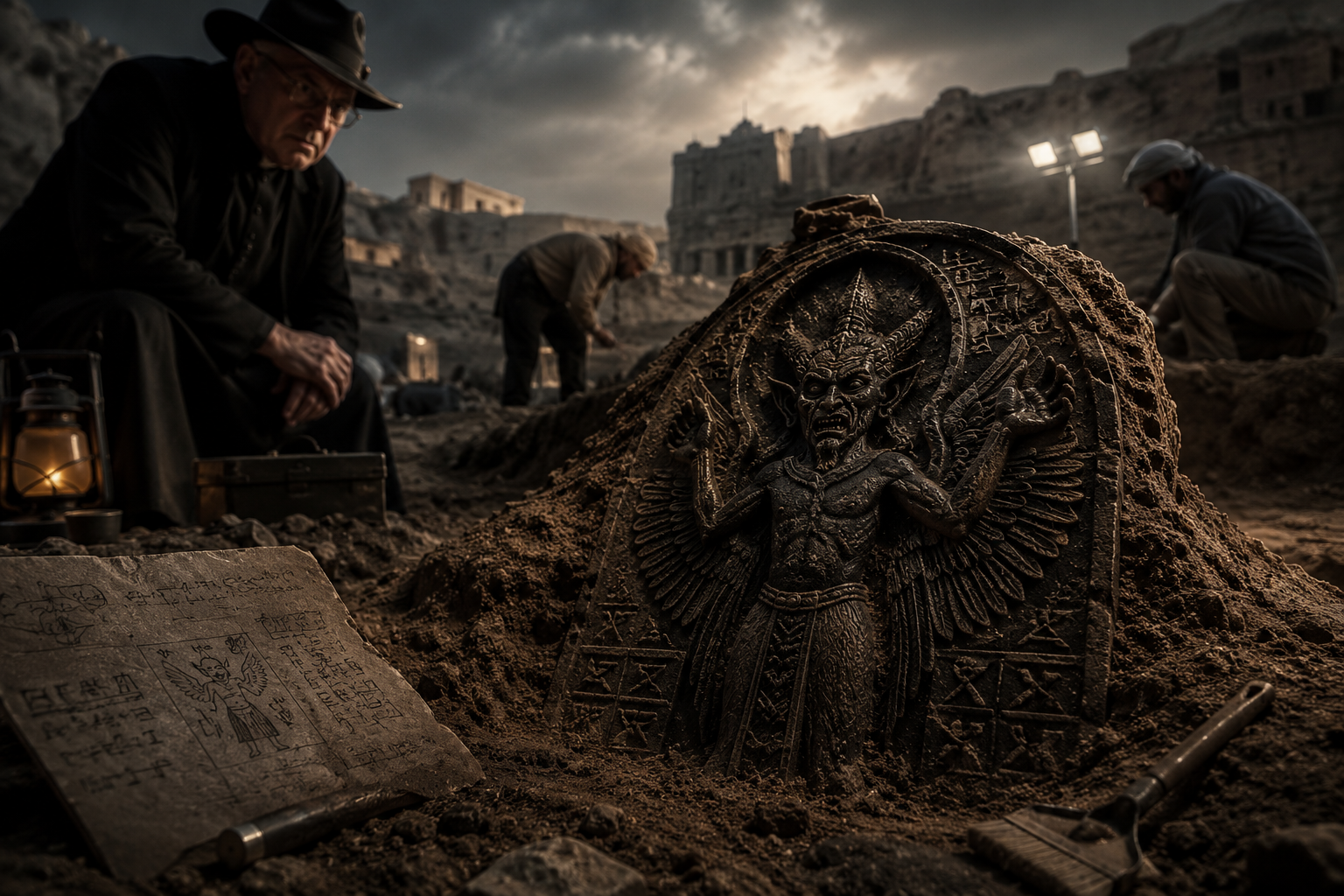
At first glance, the Iraq prologue looks like atmospheric exposition.
Ancient excavation.
Father Merrin.
Archaeological dread.
Pazuzu.
In a lesser film, this simply means: Here is the ancient evil. It will matter later.
But The Exorcist is doing something smarter.
This is not exposition.
This is infrastructure initialization.
Before the film introduces medicine, psychiatry, domestic life, or modern rationality, it begins in excavation.
Buried history.
Ancient substrate.
Forgotten architecture.
That matters.
Because the implication is not that evil arrives.
The implication is that evil was already here.
Buried.
Waiting.
Modern consensus reality is not foundational.
It is a surface layer.
A temporary interpretive framework laid over something older and far less merciful.
And Merrin’s role is crucial.
He is not discovering the impossible.
He is recognizing something familiar.
That is far more disturbing.
Discovery suggests randomness.
Recognition suggests recurrence.
This has happened before.
Which quietly introduces one of the film’s darkest ideas:
What if evil is not an intrusion into reality—
but part of reality’s substrate?
And yes, the film also quietly pokes at modern interpretive arrogance.
Human civilization spends thousands of years developing metaphysical frameworks for evil, possession, spirits, and unseen realities.
Then modernity arrives in a white lab coat and says:
“Thank you. We have psychiatry now. We'll take it from here.”
That’s not the film rejecting science.
Quite the opposite.
Its point is much more unsettling:
science behaves exactly as science should—
and still encounters something it cannot classify.
That is the real horror.
PART II — CONSENSUS REALITY COLLAPSE
If Iraq establishes that something ancient may exist beneath modern reality, Georgetown gives us the opposite:
order.
Normality.
Legibility.
Chris MacNeil’s world is affluent, rational, emotionally coherent.
That matters.
Because horror like this only works if consensus reality feels authentic before it fractures.
And The Exorcist is remarkably disciplined.
It does not begin with overt supernatural horror.
It begins with anomaly.
Noises in the attic.
A shaking bed.
Behavioral shifts.
Captain Howdy.
Mood changes.
Nothing that immediately requires a metaphysical explanation.
At this stage, every interpretation remains reasonable.
Stress.
Imagination.
Psychological disturbance.
Developmental instability.
And this is what separates The Exorcist from lesser horror.
No one behaves irrationally.
Chris does not call a priest.
She calls doctors.
Then specialists.
Then more specialists.
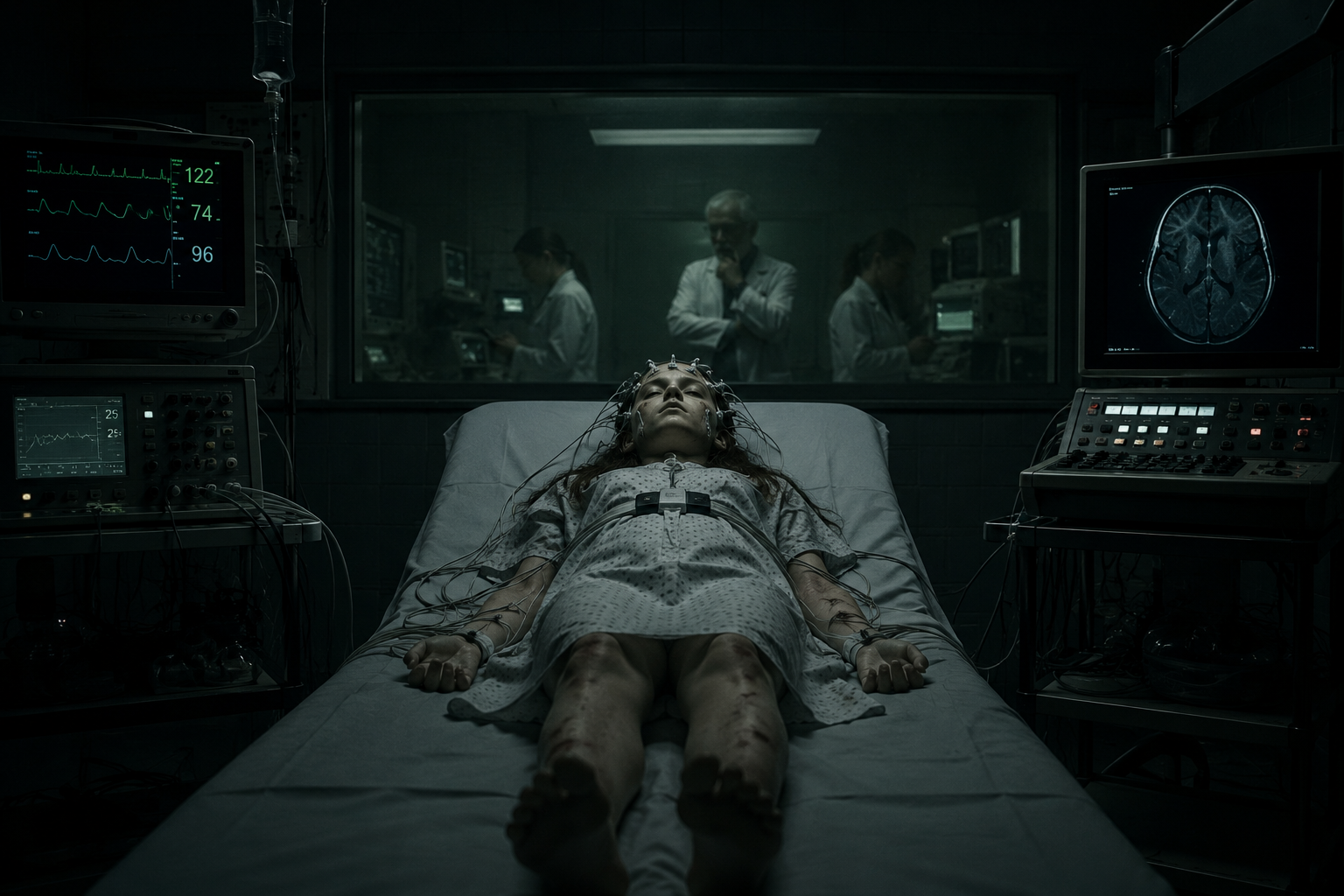
Which leads to one of the most horrifying sequences in cinema—not because of anything supernatural, but because of institutional realism.
No demon.
No gothic theatrics.
Just restraint.
Needles.
Machines.
Procedure.
Medicine becomes horror because the system functions exactly as designed—
and still fails.
That is existential terror.
Not corruption.
Not incompetence.
Competence.
Good-faith expertise.
Methodological rigor.
And still: failure.
The horror is not that the adults are stupid.
The horror is that reality may contain categories their systems cannot process.
As Regan escalates—impossible knowledge, voice transformation, grotesque physical impossibility—the central question shifts.
Not:
What is happening to Regan?
But:
What happens when every explanatory framework fails at once?
Even psychiatry never truly surrenders.
Exorcism is framed not as metaphysical reality, but therapeutic ritual.
Reality must still conform to the model.
And then comes Father Karras.
The perfect systems-horror protagonist.
Priest.
Psychiatrist.
Skeptic.
Believer.
A man suspended between incompatible systems of meaning.
He is not merely confronting evil.
He is confronting the collapse of every framework he inhabits.
That is what makes The Exorcist psychologically devastating.
Not possession.
Interpretive collapse.
PART III — THE FAILED REALITY CHAMBER
By the final act, The Exorcist is no longer operating as a conventional possession narrative.
It has become a containment narrative.
And the setting tells the story.
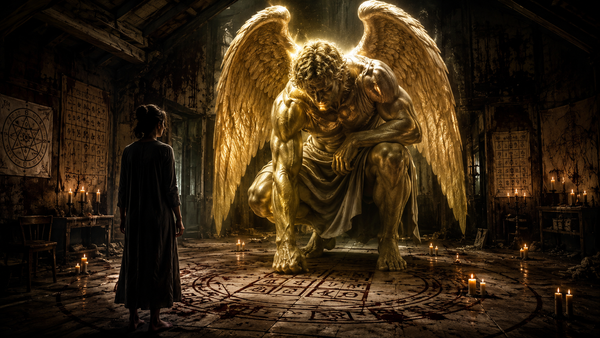
Regan’s bedroom is no longer a child’s bedroom.
It is no longer domestic space.
It has been operationally reclassified.
Temperature collapses.
Breath becomes visible.
The environment turns hostile.
The familiar becomes alien.
A normal bedroom transforms into something closer to an isolation chamber—a failed laboratory of metaphysical containment.
This is not simply a haunted room.
It is a localized rupture in consensus reality.
A failed reality chamber.
And that distinction matters.
Because the horror is no longer that Regan is behaving strangely.
The horror is that intelligible reality no longer functions inside this space.
The film expresses that collapse through a series of iconic violations—not because they are shocking effects, but because each represents a failure of classification.
Take the head rotation.
Often reduced to spectacle.
But the real horror is interpretive.
The human body ceases to obey the rules by which we understand embodiment.
The body becomes unreadable.
That is interpretive annihilation.
Then the “Help Me” moment.
Perhaps even more disturbing.
Because the question is no longer bodily violation.
It is identity violation.
Is Regan still present?
Suppressed?
Partitioned?
Intermittently accessible?
Gone?
This is not possession as spectacle.
It is ontological uncertainty.
We no longer know what a person is.
Then the crucifix scene.
Often dismissed as pure blasphemous shock.
But psychologically, it is structural inversion.
The sacred symbol—the infrastructure of spiritual protection—is weaponized against itself.
The symbolic order becomes unstable.
The systems meant to preserve meaning now participate in its collapse.
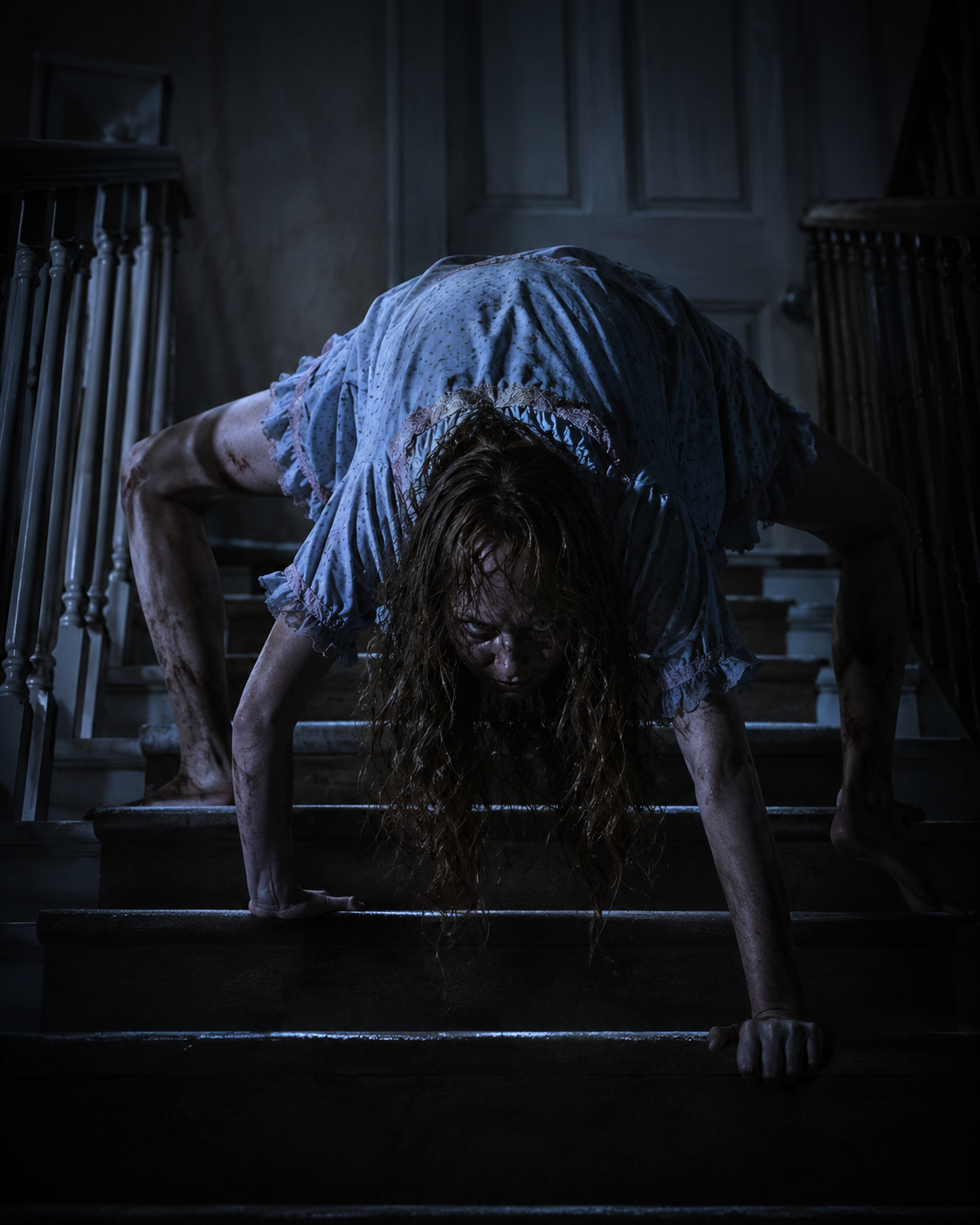
Even the spider walk functions similarly.
Not merely disturbing movement.
Corrupted embodiment.
Human motion rendered illegible.
The body as failed interface.
Every major horror beat in the final act expresses the same thesis:
reality has ceased behaving according to known interpretive rules.
That is why The Exorcist remains so powerful.
Its horror is not “a demon does scary things.”
Its horror is watching the categories we rely upon—body, identity, space, meaning, reality itself—systematically dismantled.
PART IV — RECOGNITION, CONTAINMENT, AND SYSTEM FAILURE
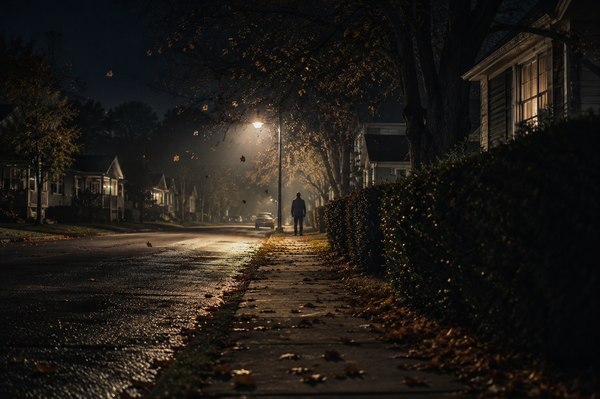
One of the most iconic images in horror history is Father Merrin arriving beneath the streetlamp.
And the reason that image lands is not merely aesthetic.
It is structural.
For most of The Exorcist, everyone exists inside interpretive uncertainty.
Doctors are confused.
Psychiatrists are confused.
Chris is confused.
Karras is conflicted.
Everyone is still trying to classify the anomaly.
Then Merrin arrives.
And something changes immediately.
Not because he is physically imposing.
Not because he carries spiritual authority.
Because he recognizes the architecture.
Merrin does not enter the house like a man confronting the impossible.
He enters like a man returning to a known operational environment.
No confusion.
No diagnostic hesitation.
Recognition.
And that changes the emotional grammar of the film.
The audience shifts from:
What is happening?
to:
Oh. This has happened before.
And that may be even more disturbing.
Because discovery suggests randomness.
Recognition suggests recurrence.
Procedure.
A known category of metaphysical failure.
Then comes the ending.
On the surface, Karras’s final act is heroic sacrifice.
A priest gives his life to save a child.
And that reading is valid.
But through the Horror Processor lens, something colder is happening.
This is containment.
The anomaly cannot be reasoned with.
It cannot be medically resolved.
It cannot be psychiatrically integrated.
So it must be transferred.
Contained manually.
At catastrophic personal cost.
And that brings us to the real thesis.
The Exorcist is not terrifying because a demon possesses a child.
That is simply the narrative mechanism.
The deeper horror is the collapse of every trusted interpretive system under metaphysical pressure.
Medicine fails.
Psychiatry fails.
Language fails.
Identity fails.
Architecture fails.
Consensus reality fails.
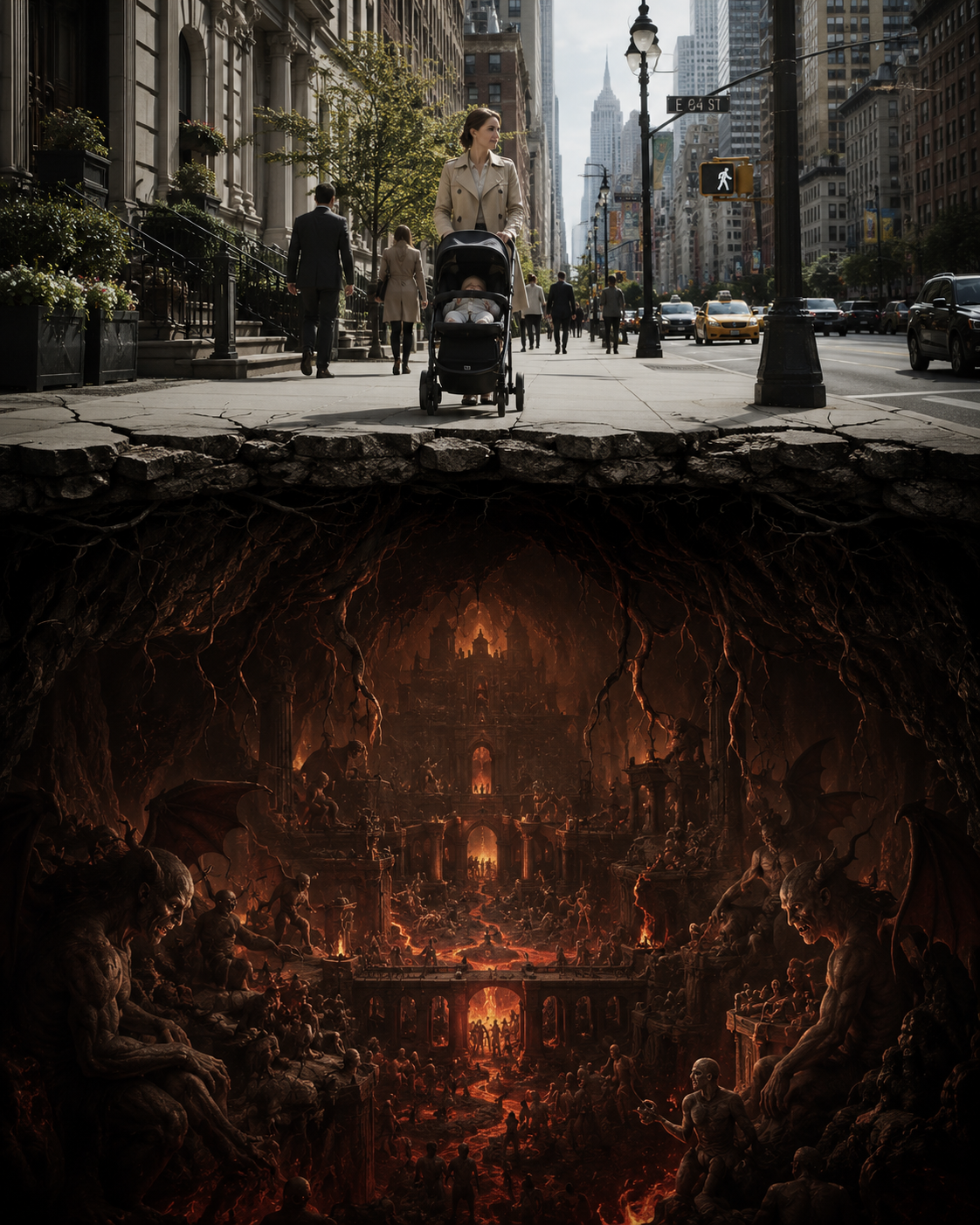
And what remains is a possibility far more disturbing than possession:
that reality contains hostile structures older than our institutions, older than our science, older than our confidence.
Which means the true horror in The Exorcist is not the demon.
It is the possibility that the thing beneath the floorboards was there long before we built the house—that the ancient presence did not invade our reality; our reality was only ever a temporary structure built over theirs.